Servo Press Cylinder technology is changing how manufacturers manage force, speed, accuracy, and energy use. In modern stamping lines, a small positioning error can leave visible marks on a formed panel. Excess heat can shorten seal life. Poor synchronization may create costly downtime.
This article introduces ten leading Servo Press Cylinder manufacturers worldwide. The selection considers engineering capability, product reliability, application experience, global support, and documented innovation. It also examines practical details, including force control, response time, stroke stability, sealing design, cooling performance, and integration with industrial control systems.
As Stefan Klebert, a forming-technology executive at Schuler, has emphasized, “Digitalization makes forming technology more flexible, transparent, and efficient.” That principle matters here. A cylinder is not judged only by its rated force. Its value appears during repeated cycles, difficult materials, changing production loads, and demanding maintenance schedules.
The ranking is not absolute. Market leadership can depend on region, industry, service access, and machine configuration. A manufacturer trusted in automotive production may not suit a compact appliance line. Some suppliers publish extensive technical data. Others provide less public information, which makes comparison harder.
Readers should verify specifications directly with manufacturers. Check certification, warranty terms, replacement-part availability, and field references. Test results can also change with oil quality, controller tuning, and installation conditions.
This overview aims to support careful research, not replace engineering evaluation. The strongest choice is rarely the most famous name. It is the supplier that consistently matches the press, process, and long-term operating reality.
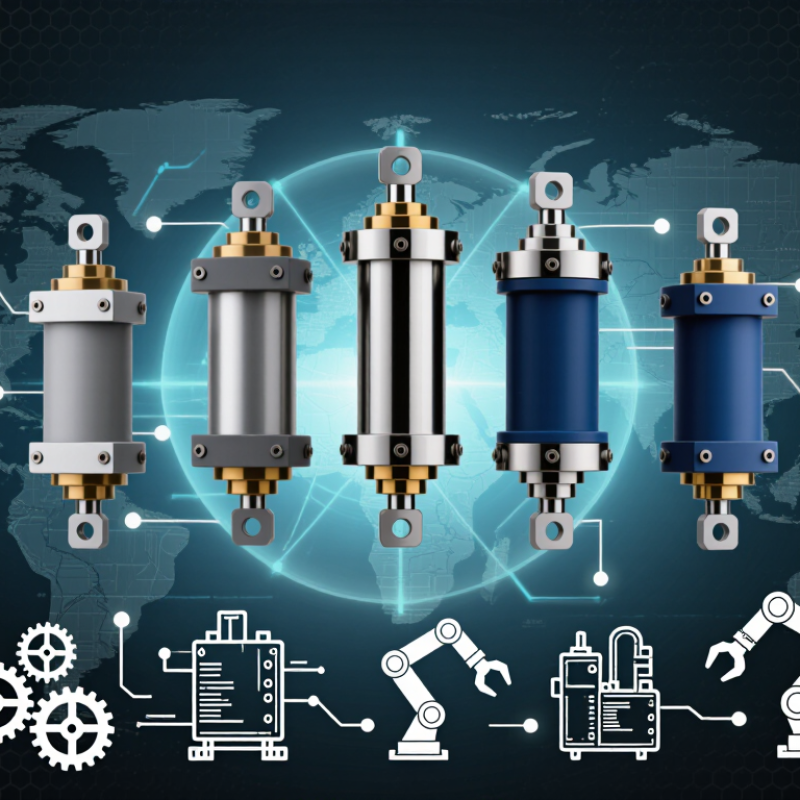
A servo press cylinder is an electromechanical actuator that converts a servo motor’s rotation into controlled linear force and movement. Unlike a conventional pneumatic cylinder, it can adjust speed, position, and pressing force through a feedback system. An encoder tracks motion, while a load cell or force sensor may monitor the workpiece load. That matters.
Inside the assembly, a motor turns a ball screw or roller screw, which drives the ram along a guided axis. The frame, bearings, lubrication, and screw sizing all influence stiffness, accuracy, and service life. In practice, designers match the actuator’s force and stroke to the task, then check duty cycle, heat, and side loading. Small details count. A misaligned fixture can undermine otherwise precise control.
These cylinders are used for press fitting bearings, joining components, forming small parts, and testing material strength. A production cell may record force against displacement for each cycle, helping operators spot an incomplete fit or an unexpected obstruction. Yet feedback cannot fix poor tooling or an unsuitable process window. Servo control is useful, not magic. Real applications still need trials, calibration, and maintenance; even a well-specified unit can perform poorly when the surrounding machine is not designed for its loads.
Ranking servo press cylinder manufacturers requires comparable evidence, not brochure claims. Core measures should include rated force, force-control accuracy, stroke, repeatability, cycle life, and thermal drift. Test results matter most when load, speed, and temperature are stated. Small differences can change part quality.
The IFR World Robotics 2024 report counted 4,281,585 industrial robots operating in factories in 2023, a 10% rise year over year. This growth makes integration and uptime important ranking criteria. Reviewers should check controller compatibility, documented interfaces, maintenance intervals, spare-part availability, and service response. The IFR figure describes robot installations, not servo cylinders directly; it signals automation context, not proof of cylinder performance.
Safety and quality systems also need evidence. Compare risk documentation against ISO 12100 and functional-safety design against ISO 13849-1, while verifying claims through certificates or independent test records. Ask for force-versus-position curves, endurance-test conditions, and energy use per cycle. No single score is neutral. Real shop floors vary. A ranking should publish its weighting, separate verified data from vendor-submitted figures, and disclose missing results. Cost matters, but low purchase prices can hide frequent seal replacement or difficult commissioning. Some evidence will remain incomplete; that uncertainty should be visible.
Criteria for Ranking the World’s Leading Servo Press Cylinder Manufacturers
The chart shows a proposed evaluation rubric, not measured scores or a verified ranking of manufacturers. The weights prioritize press performance and control accuracy, while also accounting for durability, integration, safety, and service support.
The ten profiles compare servo press cylinder manufacturers through practical engineering factors, not marketing claims. They examine product range, force capacity, stroke options, control integration, and documented testing. Some manufacturers focus on compact cylinders for assembly cells, while others support larger, custom-built press systems. A useful profile also explains how each supplier handles installation guidance, spare parts, and technical questions. These details matter when a cylinder must fit an existing frame or maintain repeatable force across long production runs.
Tips: Check rated force, stroke, speed, and duty cycle against your real process. Ask for test data and clarify what the quoted configuration includes. Fit matters.
Specifications alone can hide important differences. Two cylinders with similar ratings may vary in sensors, mounting dimensions, or service requirements. Profiles should distinguish published data from information confirmed directly with the manufacturer. Be cautious with broad claims about precision or lifespan; results depend on tooling, setup, and maintenance. Even a detailed comparison has limits, and supplier information may not show performance under your exact operating conditions. A sample cycle test can expose gaps before purchase.
Choosing among the top servo press cylinder manufacturers requires more than comparing catalog prices. The key question is technology. Electric servo cylinders offer clean operation, precise positioning, and simple energy monitoring. Servo-hydraulic designs can deliver higher peak force and tolerate demanding forming cycles. However, they may require pumps, filtration, and scheduled maintenance. A factory trial should measure force accuracy, repeatability, cycle time, noise, and heat buildup.
Performance depends on the complete system, not the cylinder alone. Check encoder resolution, response time, stroke stability, and overload protection. A reliable supplier should provide test data, calibration records, and clear tolerances. Ask how performance changes after thousands of cycles. Short-term demonstrations can mislead.
Customization often separates capable manufacturers from ordinary suppliers. Useful options include mounting geometry, stroke length, force range, cooling methods, seals, sensors, and communication protocols. The best design fits the press frame without creating difficult service access. Small details matter. A poorly placed connector can slow maintenance.
Support should include commissioning guidance, spare-part planning, diagnostic software, and technician training. Documentation must explain fault codes in practical language. Response time also deserves a written commitment. Still, no supplier is perfect. Specifications may look complete while integration exposes hidden limits. Independent testing, sample production, and a realistic acceptance procedure can reveal those weaknesses before full-scale installation.
Anonymous, illustrative comparison of common supplier capability profiles. The entries are not named companies, verified manufacturer rankings, or company-specific product specifications. Servo press specifications vary by model, tooling, and application.
| Profile | Typical Application Focus | Common Drive Technology | Representative Force Range | Control and Monitoring | Customization Options | Integration and Support Considerations |
|---|---|---|---|---|---|---|
| Supplier Profile 1 | Precision assembly and component insertion | Electric servo motor with ball-screw actuator | Typically selected from low- to mid-force configurations; exact capacity is model-specific | Programmable position, speed, and force with feedback from sensors | Stroke, mounting arrangement, tooling interface, and force-monitoring limits | Confirm controller communication options, commissioning services, and local service coverage |
| Supplier Profile 2 | High-cycle production and repetitive pressing | Servo-driven electromechanical press with motion controller | Configuration-dependent; commonly specified to suit the required process load | Recipe-based motion profiles and process data capture may be available | Cycle profile, sensors, guarding interfaces, and machine mounting | Assess duty-cycle limits, maintenance intervals, spare-parts availability, and production-line integration |
| Supplier Profile 3 | Force-displacement-controlled joining | Servo actuator with closed-loop force and position control | Specified for the part and tooling load; capacity differs across product families | Force-displacement monitoring, pass/fail windows, and recorded process curves | Quality limits, data format, sensors, and custom press tooling | Check traceability features, data export, validation support, and controller compatibility |
| Supplier Profile 4 | Compact benchtop assembly stations | Compact electric servo press unit | Usually aimed at lower-load applications; confirm the rated force and duty cycle for each model | Basic programmable position and force settings; options vary by controller | Compact frame, stroke, operator interface, and workholding | Review installation requirements, operator training, and availability of replacement components |
| Supplier Profile 5 | Automated production lines and robotic cells | Servo press integrated with a programmable automation controller | Selected according to application force and line cycle requirements | PLC communication, interlocks, status signals, and process monitoring options | Robot interfaces, safety circuits, custom brackets, and station-specific tooling | Confirm supported industrial protocols, safety documentation, and system-integration responsibility |
| Supplier Profile 6 | Heavy-duty forming and higher-load pressing | High-capacity electromechanical servo press architecture | May extend into higher-force configurations; verify rated force, frame capacity, and duty limits | Programmable motion with load monitoring; advanced data functions depend on the system | Structure, stroke, tooling, cooling, and application-specific force monitoring | Evaluate foundation and guarding requirements, commissioning support, and long-term service capability |
| Supplier Profile 7 | Laboratory, pilot-line, and process-development work | Servo press with adjustable motion profiles and reusable recipes | Chosen to cover the required test and development loads | Fine adjustment of speed and position; data logging may be offered as an option | Interchangeable tooling, fixtures, sensors, and software configuration | Ask about software access, calibration procedures, training, and support for process trials |
| Supplier Profile 8 | Clean or controlled manufacturing environments | Electric servo actuator configured for the installation environment | Application-specific; environmental suitability does not determine force capacity | Position and force control options depend on the selected drive and sensor package | Sealing, materials, cable routing, lubrication, and cleanability requirements | Verify environmental ratings and documentation for the actual configuration; do not infer them from the product family |
| Supplier Profile 9 | Custom machinery and specialized assembly processes | Servo cylinder or press unit configured for a machine-builder project | Engineered around the specified load, stroke, and cycle profile | Control features selected to match the machine architecture and process needs | Custom end fittings, stroke, mounting, cables, sensors, and control interfaces | Clarify engineering lead time, drawing approval, documentation, and division of integration work |
| Supplier Profile 10 | Flexible production with multiple part variants | Programmable servo press with recipe and changeover functions | Selected to accommodate the required range of part and process loads | Stored programs, configurable limits, and optional process-data recording | Recipe structure, quick-change tooling, user access, and traceability settings | Assess usability, software maintenance, operator training, and compatibility with plant data systems |
Comparison note: There is no universal force, stroke, accuracy, cycle-life, or service specification for servo press cylinders. Request current datasheets and confirm the complete machine configuration, including actuator, controller, sensors, tooling, and operating conditions, before comparing suppliers.
Selecting a servo press cylinder manufacturer requires more than comparing rated force or catalog prices. Start with the process. Record required tonnage, stroke length, cycle frequency, pressing speed, and positional accuracy. A supplier should provide measured performance data, not broad marketing claims. Feedback resolution, thermal stability, bearing design, and overload protection deserve close attention. Small details matter.
The market is becoming more automated. The International Federation of Robotics reported 541,302 industrial robots were installed worldwide in 2023, a 10% year-on-year increase. This growth raises expectations for synchronized motion and repeatable pressing. Choose a manufacturer with documented integration experience, including fieldbus compatibility, controller tuning, and data logging. Ask for test results under conditions similar to yours. A cylinder rated for 1,000 kN may still perform poorly during rapid, repeated cycles.
Reliability also depends on service quality. Check spare-part availability, repair procedures, commissioning support, and response times. Review quality systems, material traceability, and compliance documentation. ISO 9001 certification is useful, but it does not replace application evidence. I would request a witnessed factory acceptance test, preferably with your tooling and production recipe. My own checklist can fail when it ignores maintenance access. Leave room around seals, sensors, and mounting bolts. The cheapest quotation may become expensive after one avoidable shutdown.
It is an electromechanical actuator that converts motor rotation into controlled linear movement. An encoder tracks position. A force sensor may monitor pressing load.
A motor turns a ball screw or roller screw. The screw drives a guided ram along its axis. Frame stiffness and bearing quality affect accuracy.
They support bearing press fitting, component joining, small-part forming, and material-strength testing. A production cell can record force against displacement.
Record required force, stroke, speed, cycle frequency, and positional accuracy. Also check heat, duty cycle, side loading, and overload protection.
Feedback helps control position, speed, and force. It can reveal an incomplete fit or unexpected obstruction. But feedback is not magic.
Electric designs offer clean operation and precise positioning. Servo-hydraulic systems can provide higher peak force. They may need pumps, filtration, and more maintenance.
Request measured test data, calibration records, and clear tolerances. Test force accuracy, repeatability, cycle time, noise, and heat buildup.
Options include stroke length, force range, mounting geometry, cooling, seals, sensors, and communication protocols. A poorly placed connector can delay servicing.
Support may include commissioning guidance, spare-part planning, diagnostic tools, and technician training. Fault codes should be explained in practical language.
Do not compare only rated force or purchase price. Poor tooling, limited maintenance access, or frame misalignment can damage an otherwise precise system. No checklist is perfect.
This article provides a practical overview of the Servo Press Cylinder, explaining its basic definition, mechanical design, operating principles, and growing role in modern industrial automation. It examines how servo-driven systems deliver precise force, speed, position, and motion control, making them suitable for applications such as forming, assembly, stamping, pressing, testing, and other demanding manufacturing processes. The discussion also highlights important performance factors, including energy efficiency, repeatability, durability, safety, and ease of integration.
To identify the world’s leading servo press cylinder manufacturers, the article evaluates criteria such as engineering capability, product quality, customization options, production reliability, technical innovation, after-sales support, and global service coverage. It then compares the selected manufacturers in terms of technology, performance, flexibility, and customer assistance, helping readers understand their differences. Finally, the article offers practical guidance for selecting the right supplier based on application requirements, load capacity, stroke, precision, control compatibility, operating environment, maintenance needs, budget, and long-term support.

