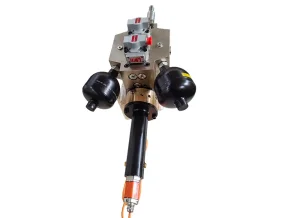
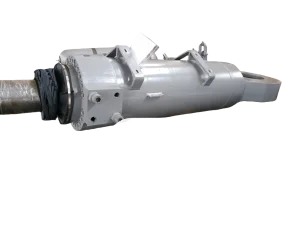
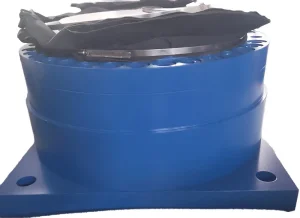
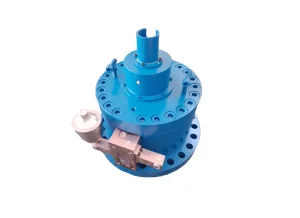
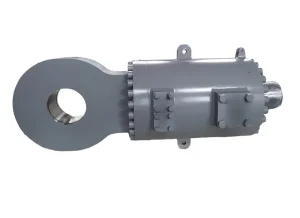
Direct OEM interchangeability, optimized sealing mechanics, and extreme structural durability engineered for continuous industrial service.
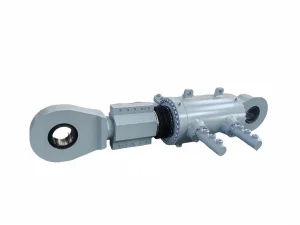
Evaluating total cost of ownership (TCO), risk mitigation strategies, and technical benchmarks when sourcing industrial hydraulic actuators for heavy machinery.
Continuous-duty processing plants in cement, metallurgy, and mining lose up to $50,000 per hour during unscheduled shutdowns. Enterprise buyers prioritize actuators designed with double-seal redundancy, high-yield alloy barrels (e.g., 42CrMo4), and laser-clad piston rods to eliminate catastrophic seal blowouts.
Global maintenance and repair operations (MRO) require drop-in replacement units that match exact flange configurations, port interfaces, stroke limits, and pressure ratings of major OEMs such as Loesche, FLSmidth, Pfeiffer, CITIC, and Leejun without structural modifications.
As industrial automation advances toward Industry 4.0, procurement managers favor hydrostatically balanced and low-friction clearance seal servo cylinders that reduce system hysteresis, minimize thermal energy losses, and deliver dynamic control loops with response times below 10 milliseconds.
| Evaluation Parameter | Generic Market Replacements | Original OEM Components | Xuanda Engineered Actuators |
|---|---|---|---|
| Mean Time Between Failures (MTBF) | 8,000 – 12,000 Hours | 25,000 – 30,000 Hours | 32,000+ Hours (Enhanced Tribology) |
| Piston Rod Surface Treatment | Single Hard Chrome (20 µm) | Double Hard Chrome (30 µm) | HVOF Laser Cladding / Nickel-Chrome (50 µm+) |
| Seal Friction Coefficient ($\mu$) | 0.08 – 0.12 (High Stick-Slip) | 0.04 – 0.06 (Standard PTFE) | < 0.005 (Hydrostatic / Clearance Seals) |
| Lead Time & Customization | 4-6 Weeks (Fixed Stock) | 16-24 Weeks (High Margin Premium) | 4-8 Weeks (Fully Customized Drawing Support) |
| Quality Certification Compliance | Basic ISO 9001 | ISO 9001, PED 2014/68/EU | ISO 9001:2015, CE, ATEX, Pressure Vessel Test (100%) |
Detailed insight into how custom hydraulic cylinders drive critical plant infrastructure across cement production, mineral grinding, steelmaking, and energy sectors.
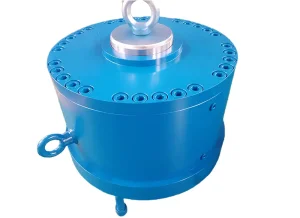
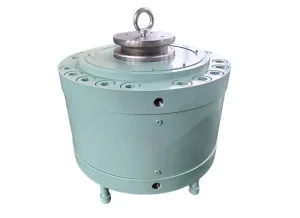
In grinding applications for raw materials, cement clinker, and slag (such as Loesche LM, FLSmidth ATOX, Pfeiffer MPS, UBE UM, and TCD/TRM mills), hydraulic loading cylinders supply the grinding pressure necessary for comminution. These cylinders experience high-frequency dynamic vibrations, transient pressure spikes exceeding 350 bar, and abrasive cement dust environments.
Technical Features: Integrated nitrogen bladder accumulators, high-temperature Viton/PTFE composite seals, spherical bearing mountings to absorb roller tilting, and internal linear position feedback sensors.
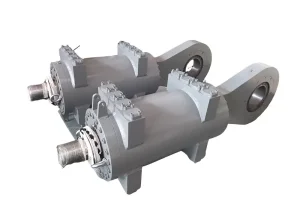
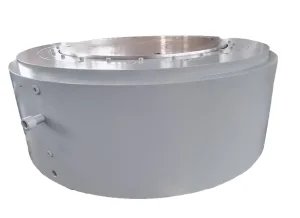
Roller presses (e.g., CITIC Heavy Industries, Chengdu Leejun CLF series, HCRI) subject hydraulic actuation cylinders to immense crushing loads. The cylinders maintain constant gap pressure between moving and fixed rollers, enduring continuous shock loads when tramp metal or ungrindable feed enters the grinding zone.
Technical Features: Compact diamond-shaped housing geometries, heavy-wall forged steel barrels, anti-cavitation valve blocks, and ultra-high-pressure polyurethanes qualified for 40 MPa dynamic operation.
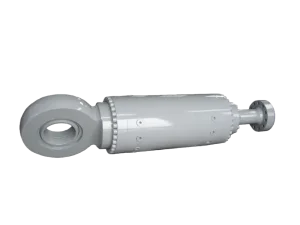
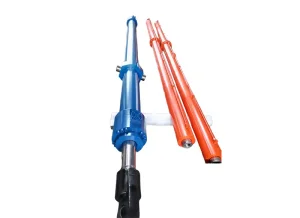
Cement rotary kilns operate on inclined axes and require hydraulic thrust roller cylinders to control axial kiln drift. By applying controlled mechanical thrust against the kiln tire, the hydraulic cylinder ensures uniform wear across support rollers and prevents mechanical binding.
Technical Features: Precision directional control manifolds, thermal expansion compensation mechanisms, heavy duty trunnion mountings, and dust-impermeable rod wiper seals.
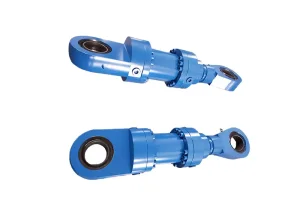
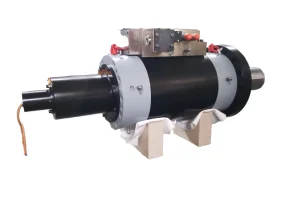
Aerospace simulators, structural test stands, and high-speed industrial robotics require zero hysteresis actuation. Hydrostatic support and clearance seal servo cylinders utilize fluid dynamics to float the piston on a pressurized oil film, eliminating mechanical contact friction.
Technical Features: Sub-micron positioning resolution, zero stick-slip effect, infinity-life seals under dynamic high-speed oscillation, and integrated LVDT/magnetostrictive transducers.
Pushing the boundaries of hydraulic actuation through advanced material science, fluid dynamic lubrication, and smart sensor integration.
By routing high-pressure supply oil into machined hydrostatic pockets along the cylinder guide bushings, the piston rod remains centered under severe radial side loads (up to 300 kN). Metal-to-metal contact is entirely eliminated, extending component life in continuous duty cycles.
Utilizing micro-gap machining tolerances (3 to 5 microns) between the honed barrel bore and ground piston outer diameter, clearance seal cylinders operate with controlled laminar fluid bypass instead of elastomeric contact seals. Result: Zero breakout friction and operational response up to 100 Hz.
Next-generation hydraulic cylinders incorporate internal magnetostrictive position sensors, embedded piezoelectric vibration accelerometers, and integrated oil temperature/pressure transducers. Real-time data streams into plant SCADA systems via IO-Link or CANopen protocol for predictive maintenance.
Stress & buckling analysis via ANSYS simulation
42CrMo / ST52 deep hole boring & micro-honing
HVOF alloy / double-chrome rod surfacing
Dust-free automated seal & guide ring assembly
Full pressure, leakage & dynamic frequency validation
Every hydraulic cylinder exported by Changzhou Xuanda adheres to stringent international manufacturing standards, material traceability protocols, and rigorous quality assurance testing.
Certified quality management across raw material procurement, CNC machining tolerances (IT6/IT7 grade), heat treatment verification, and assembly inspections.
Complete EN 10204 3.1 material certificates for all forged barrels, rod stocks, and end flanges. Ultrasonic non-destructive testing (NDT) applied to critical welds.
Engineered to meet European Pressure Equipment Directive (PED 2014/68/EU) and ASME Section VIII design guidelines for heavy industrial pressure vessels.
Optional ATEX certification for cylinders installed in hazardous dust environments, including coal grinding vertical mills and grain processing facilities.
A technical diagnostic reference compiled by Xuanda’s field support engineers to assist plant operators in identifying and resolving common hydraulic failures.
Mechanism: Entrained air bubbles in hydraulic oil compress violently when subjected to high pressure spikes in mill loading systems, producing localized temperatures above 1,000°C that burn elastomeric seals.
Engineering Solution: Install automated air bleed valves at top dead center and switch to polyether-based polyurethane seals with high thermal resistance.
Mechanism: Severe roller tilting or asymmetrical clinker bed thickness in vertical mills generates transverse forces that crush standard bronze guide bushings, causing metal-to-metal contact.
Engineering Solution: Retrofit with hydrostatic guide pockets or composite synthetic guide rings, and apply HVOF laser cladding (Cr3C2-NiCr) for superior hardness (>62 HRC).
Mechanism: Pressure surges in high-pressure roller presses exceed seal back-up ring gap limits, nibbling away seal edges and creating internal fluid bypass.
Engineering Solution: Utilize custom-machined PEEK anti-extrusion rings paired with stepped PTFE secondary seals designed for dynamic pressures up to 45 MPa.
Mechanism: Rapid fluid decompression during cylinder retraction creates localized vapor cavity collapses, pitting internal oil passages and valve block faces.
Engineering Solution: Re-engineer fluid gallery geometry with smooth radius turns, optimize spool throttling curves, and implement stainless steel port inserts.
Direct technical answers addressing engineering customization, reverse-engineering services, seal selection, and global shipping logisitics.
Yes. We specialize in producing exact drop-in replacements for major OEM vertical roller mills (Loesche, FLSmidth ATOX, Pfeiffer MPS, UBE UM, TCD/TRM) and roller presses (CITIC Heavy, Chengdu Leejun, HCRI). If original engineering drawings are unavailable, our technical team can reverse-engineer worn samples, nameplate data, or field dimensions to produce fully validated CAD models before machining.
Clearance seal cylinders rely on high-precision micro-gaps (3-5 µm) between the piston and bore, completely eliminating dynamic contact friction for high-speed dynamic applications. Low-friction seal cylinders utilize specialized PTFE and bronze-filled elastomer compounds to minimize stick-slip effect in standard servo loops. Hydrostatic support cylinders float the piston rod on a continuous pressurized oil film, allowing the cylinder to handle immense side loads (over 300 kN) without mechanical wear.
We offer double hard chrome plating (minimum 30-50 µm thickness), Nickel-Chrome electroplating for marine environments, and state-of-the-art HVOF (High-Velocity Oxygen Fuel) laser cladding (such as Carbide or Stainless Steel alloys) providing surface hardness above 62 HRC and salt-spray corrosion resistance exceeding 1,000 hours under ASTM B117 standards.
Every manufactured cylinder undergoes 100% factory acceptance testing (FAT) on our automated hydraulic test stands. Testing protocols include internal/external pressure proof testing (up to 1.5x working pressure), dynamic friction monitoring, stroke verification, and zero-internal-leakage hold tests in compliance with ISO 10100 standard. Full test certificates and inspection video documentation are provided for export orders.
Standard custom cylinder orders are typically manufactured, tested, and packaged for export within 4 to 8 weeks following technical drawing approval. For emergency breakdown maintenance cases in operating plants, expedited production schedules (2 to 3 weeks) can be arranged using pre-certified raw forging stocks.
Direct sourcing access to specialized hydraulic actuators engineered for high friction sensitivity, extreme loads, and continuous plant duty cycles.