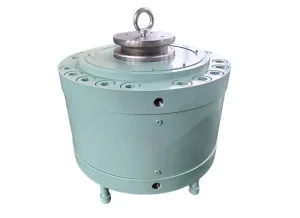
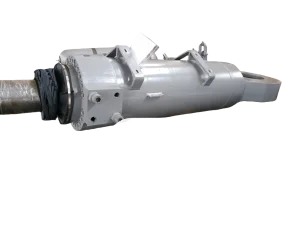
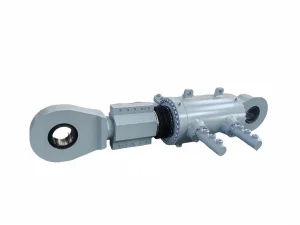
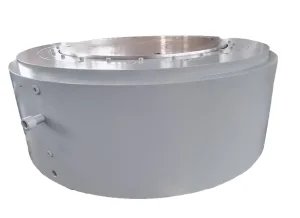
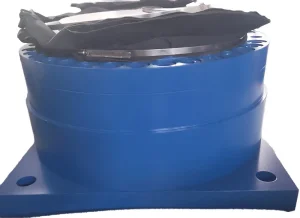
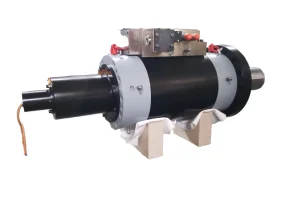
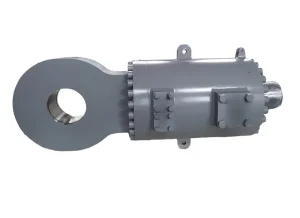
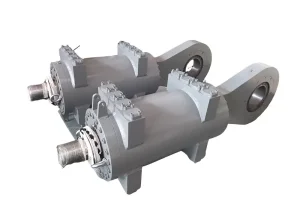
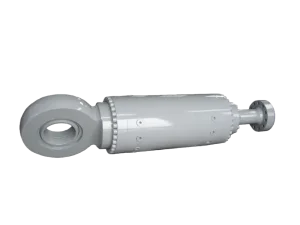
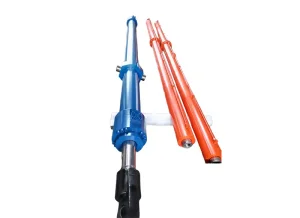
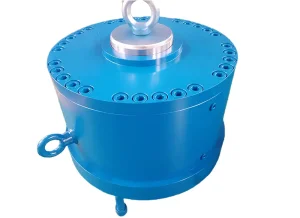
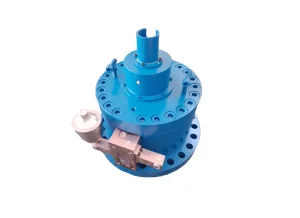
Integrated hydraulic thrust mechanisms, servo cylinders, and heavy loading equipment designed to complement large vertical boring mills and industrial grinding systems.
Analyzing the pivotal structural role of Vertical Turning Lathes (VTL) and Large Vertical Boring Mills (VBM) across global energy, infrastructure, and heavy mechanical manufacturing sectors.
Unlike horizontal turning machines where heavy workpieces cause spindle deflection and asymmetrical sag, Large Vertical Boring Mills utilize horizontal rotary worktables. Gravity works in favor of clamping stability, allowing multi-ton workpieces (e.g., turbine housings, slewing bearing rings, rotary kiln components) to seat securely without radial bending moments.
Modern industrial components require heavy material removal rates (MRR) alongside strict tolerances under continuous duty. Advanced double-column and single-column VBM structures integrate thermosymmetric frame geometry and active oil-chilled hydrostatic guide-ways to eliminate thermal drift during extended machining cycles.
As international trade compliance tightens, CE certification under the EU Machinery Directive 2006/42/EC, Low Voltage Directive 2014/35/EU, and EMC Directive 2014/30/EU serves as a mandatory benchmark. High-tier exporters engineer fully enclosed protective guarding, dual-circuit safety interlocks, and redundant hydraulic pressure monitors.
Exploring how direct-drive torque motors, hybrid hydrostatic bearings, live tooling RAM extensions, and artificial intelligence-driven predictive feedback are revolutionizing vertical turning performance.
Traditional heavy-duty mechanical roller bearings suffer from friction heat, high breakaway torque, and mechanical wear under asymmetrical loads. Leading CE-certified VBM manufacturers utilize constant-flow multi-pad hydrostatic pocket bearings. A pressurized film of viscous hydraulic oil isolates the worktable from the bed, delivering near-zero friction, infinite bearing life, and superior damping against chatter during heavy interrupted cuts.
Modern manufacturing demands single-setup complete machining (Turning, Milling, Drilling, Tapping, Grinding). Vertical boring mills equipped with high-torque RAM-integrated spindle units (ISO 50, BT50, or HSK-A100 tooling interfaces) and high-resolution C-axis rotary tables eliminate the need to transfer 50-ton workpieces between turning machines and gantry milling centers, cutting floor-to-floor cycle times by up to 45%.
Ambient shop-floor fluctuations and continuous spindle friction cause thermal elongation in the RAM, crossrail, and column columns. Modern CE-certified machines incorporate embedded PT100 thermal sensors paired with real-time CNC algorithm offsets (Siemens SINUMERIK ONE / Fanuc 31i-B). The system continuously updates axis zero positions, ensuring linear consistency throughout 24-hour continuous production runs.
By conducting structural static and dynamic FEA, stress concentrations across crossrail guide-ways and bed castings are redistributed. Optimized rib structures engineered with HT300 gray cast iron provide a damping capacity 8 times higher than fabricated steel weldments, effectively dampening tool resonance during heavy roughing operations on hard-to-machine superalloys (Inconel, Titanium, and Hastelloy).
How China's premier heavy machine tool manufacturing clusters combine advanced metallurgy, automated assembly, and vertical integration to deliver world-class VBM solutions.
Leading Chinese machine tool builders maintain full in-house capabilities: from large-capacity electric induction furnace melting and resin-sand pattern molding to stress-relieving thermal aging pits, precision slideway grinding, and final laser interferometer calibration. This avoids third-party subcontractor delays and maintains strict quality oversight.
China’s heavy machinery ecosystem ensures seamless access to high-grade raw materials (Meehanite cast iron, forged alloy steel 42CrMo), hydraulic servo valves (Rexroth/Vickers), linear scales (Heidenhain), precision bearings (SKF/TIMKEN/NSK), and premium electrical switches (Schneider/Siemens), offering unparalleled lead-time resilience.
Through optimized factory floor automation, lean production management, and scalable modular design frameworks, Chinese OEMs offer CE-certified VBM systems that achieve 100% of European heavy machining accuracy at 35% to 50% lower capital expenditure, drastically accelerating customer payback periods.
Selecting the optimal structural configuration based on workpiece payload, maximum turning height, and tooling torque requirements.
| Parameters & Features | Single-Column VBM Series | Double-Column Heavy VBM Series | Gantry Movable-Column VBM Series |
|---|---|---|---|
| Max Turning Diameter | 1,250 mm – 2,500 mm | 2,500 mm – 8,000 mm | 6,300 mm – 12,000+ mm |
| Table Load Capacity | 5 Ton – 15 Ton | 20 Ton – 80 Ton | 80 Ton – 200+ Ton |
| Main Motor Power (S1/S6) | 37 kW / 45 kW | 55 kW / 75 kW (Dual Drive Option) | 75 kW – 130 kW Direct-Drive |
| Guide-way Architecture | Hardened Box-Ways / Heavy Roller Linear | Hydrostatic Pocket Bearings (X/Z/C) | Full Hydrostatic Constant-Flow System |
| RAM Cross-Section | 200 x 200 mm or 240 x 240 mm | 280 x 280 mm or 320 x 320 mm | 360 x 360 mm up to 450 x 450 mm |
| Live Tooling Speed / Torque | 3,000 rpm / 450 Nm | 2,400 rpm / 1,200 Nm (2-Gear) | 2,000 – 4,000 rpm / High Torque Gearhead |
| CE Safety Certification | EN ISO 12100 / EN ISO 23125 | EN ISO 12100 / EN ISO 23125 | EN ISO 12100 / EN ISO 23125 |
How global plant operators utilize CE-certified Vertical Boring Mills to overcome demanding machining challenges.
Machining large wind turbine slewing rings, rotor hubs, and pitch bearings requires flawless surface finishes and circular pitch accuracy. Double-column VBMs equipped with hydrostatic tables prevent vibration mark transfer, maintaining surface roughness values as low as Ra 0.8 μm across 6-meter diameters.
Components such as Pfeiffer MPS mill tables, Loesche vertical roller mill housing bodies, and cement rotary kiln thrust rollers require heavy structural metal removal from raw castings. High-torque gear-driven VBM spindles effortlessly slice through tough skin scale and inclusions without stalling.
Machining thin-walled titanium alloy jet engine casings and rocket motor booster rings demands extreme thermal symmetry and low clamping distortion. Hydraulic multi-point chucking combined with sub-micron feedback linear scales ensures precise roundness retention post-machining.
Every vertical boring mill shipped internationally undergoes rigorous inspection protocols in accordance with European CE norms and ISO standards.
Chemical composition analysis of HT300 cast iron, ultrasonic flaw testing on bed structures, and 72-hour thermal stress relief aging.
German Waldrich Coburg slideway grinding followed by manual hand-scraping (22-25 contact spots per square inch) for optimal oil film retention.
Renishaw laser measurement of X/Z-axis pitch, yaw, roll, and linear positioning accuracy down to sub-micron resolution per ISO 230-2.
Electrical safety testing (EN 60204-1), EMC compliance verification, enclosure acoustic dB noise testing, and 48-hour continuous full-load dynamic test cuts.
Technical guidance, procurement information, and international shipping answers provided by senior machine design engineers.
Our CE-certified Large Vertical Boring Mills fully comply with the European Union Machinery Directive 2006/42/EC, Low Voltage Directive 2014/35/EU, and Electromagnetic Compatibility Directive 2014/30/EU. Harmonized standards implemented include EN ISO 12100 (Risk Assessment), EN ISO 23125 (Safety of Machine Tools - Turning Machines), and EN 60204-1 (Electrical Equipment of Machines). Standard features include fully enclosed interlocked safety doors, dual-channel safety relay systems, hydraulic clamp interlocks, and emergency braking circuits.
Hydrostatic guide-ways separate sliding metal surfaces with a continuous, pressurized oil film (0.02 - 0.05 mm thick). This provides three critical benefits: (1) Zero static/dynamic friction stick-slip, allowing precise micro-positioning of heavy crossrails; (2) Superior structural damping capacity that eliminates tool chatter during heavy interrupted cuts; and (3) Zero metal-to-metal wear, maintaining factory accuracy indefinitely even under 100-ton workpieces.
Yes. Our VBM machines can be configured as complete multi-tasking CNC Machining Centers. By equipping the heavy RAM with a high-torque C-axis live spindle unit (BT50 / CAPTO C8 tooling), automatic tool changers (ATC), automatic attachment changers (AAC) for right-angle milling heads, and auxiliary grinding attachments, a single machine can execute turning, milling, drilling, tapping, and precision grinding without remounting the workpiece.
We utilize a multi-layered thermal stability strategy: (1) Symmetric double-column mechanical structures that expand uniformly; (2) Active oil chillers circulating temperature-controlled oil through the main spindle and hydrostatic bearing system; and (3) Dynamic thermal compensation software integrated into the CNC unit (Siemens SINUMERIK or Fanuc), which receives data from multi-point PT100 temperature sensors to dynamically adjust axis offsets in real time.
We support global standard CNC platforms based on customer preference, plant standardization, and local service support. Mainstream options include Siemens SINUMERIK ONE / 840D sl, Fanuc 31i-Model B / 0i-TF, Heidenhain CNC PILOT 640, and Mitsubishi M800 series. All systems are supplied with multi-language HMI interfaces and remote telemetry support modules.
Manufacturing lead times range from 3.5 to 6 months depending on machine size and customization level (e.g., table diameter 2.5m vs 8m). Machines undergo complete factory acceptance testing (FAT) prior to disassembly. Components are rust-inhibited, vacuum sealed, and secured in heavy-duty ocean-worthy wooden cases or break-bulk vessel cradles. We provide complete export documentation, CE declarations, and dispatch field service engineers for overseas installation, commissioning, and operator training.
We utilize standard international OEM components (e.g., Rexroth valves, SKF seals, Schneider electricals, Heidenhain encoders) wherever possible, allowing localized sourcing. Additionally, we stock complete spare part packages—including replacement hydraulic cylinders, seal kits, filter elements, and solenoid valves—at our logistics hubs, ready for express air-freight dispatch within 24-48 hours.
Yes. Upon contract signing, our civil engineering team provides complete 3D foundation structural drawings, including concrete load-bearing requirements, anti-vibration damping trench layouts, anchor bolt location maps, and electrical/hydraulic utility trenching specifications to ensure seamless installation upon delivery.
Explore our range of heavy-duty hydraulic cylinders engineered to match OEM specifications across global cement lines, steel mills, and heavy equipment.