Engineered to exact OEM interface specifications for cement grinding mills, rotary kilns, roller presses, and closed-loop servo control systems.
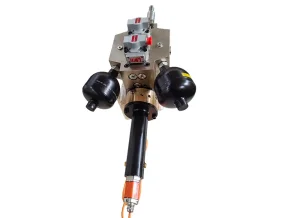
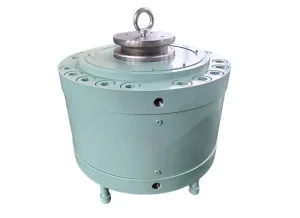
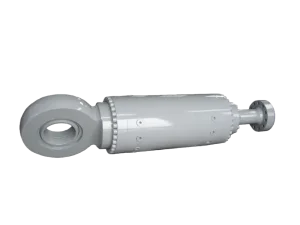
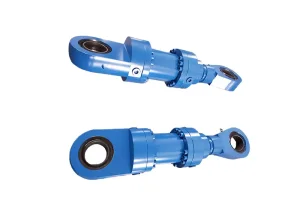
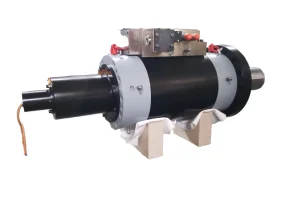
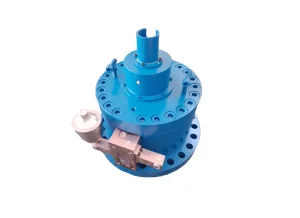
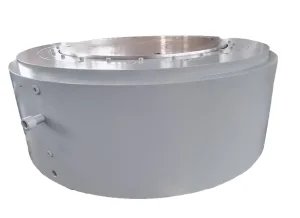
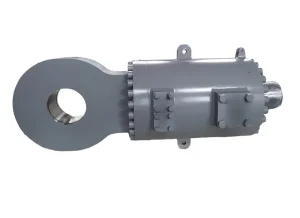
Understanding equal velocity, force balance, fluid displacement, and structural rigidity in heavy industrial automation.
A double ended hydraulic cylinder (also known as a double-rod cylinder) features a piston rod extending from both ends of the main cylinder body. Unlike standard single-rod differential cylinders where the rod side area ($A_r$) reduces net extension force, double ended cylinders maintain an identical effective surface area on both sides of the piston:
$$A_1 = A_2 = \frac{\pi}{4} (D_{bore}^2 - d_{rod}^2)$$
This structural symmetry guarantees identical force generation ($F = P \times A$) and equal linear velocity ($v = Q / A$) in both extension and retraction strokes. For precision steering gear, material testing beds, and high-frequency servo-actuated machinery, this eliminates asymmetric control algorithm compensation.
By extending the piston rod through both front and rear cylinder heads, double ended cylinders gain a crucial mechanical advantage: two points of rod bushing support separated by the full stroke distance. This dual-guided configuration drastically reduces bending moments and mechanical deflection under heavy lateral loads.
| Performance Characteristic | Single-Rod Differential Cylinder | Double Ended Hydraulic Cylinder | Industrial Sourcing Advantage |
|---|---|---|---|
| Force Symmetry | Asymmetric ($F_{ext} > F_{ret}$) | 100% Symmetric ($F_{ext} = F_{ret}$) | Simplifies hydraulic circuit design and valve sizing. |
| Fluid Displacement ($Q$) | Unequal oil volume requirements | Equal volumetric displacement | Eliminates large oil reservoir surges in closed loops. |
| Column Buckling Resistance | Moderate (Single rod guide support) | Superior (Dual gland guide bearings) | Extends fatigue life in heavy crushing & milling duty. |
| Feedback Sensor Integration | External linear transducer mounting | Hollow rod internal sensor housing | Protects LVDT / Temposonics sensors from harsh dust. |
| Seal Friction Characteristics | Unequal friction depending on direction | Balanced dual seal friction profile | Crucial for high-frequency servo testing applications. |
Combining raw material integration, state-of-the-art CNC machining, and comprehensive international quality certifications.
Chinese double ended cylinder manufacturers leverage direct access to world-class steel foundries. High-yield seamless alloy tubes (such as 27SiMn, ST52.3, 42CrMo, and 316L stainless steel) are sourced with strict ultrasonic flaw detection (NDT) standards. Cold-drawing and deep-hole boring operations are conducted in-house, drastically reducing raw material lead times compared to European or North American competitors.
The rod surface of a double ended cylinder is exposed to environmental contaminants on both sides. Leading Chinese exporters utilize specialized multi-layer chrome plating (25-50 μm thickness) or state-of-the-art Laser Cladding (HVOF Nickel-Chrome matrix alloys) to achieve corrosion resistance exceeding 1,000 hours in neutral salt spray (NSS) testing per ISO 9227.
To support high-pressure seals (Trelleborg, Hallite, NOK) without premature degradation, China factories employ German Sunnen honing centers. Inner bore roughness is held consistently between Ra 0.1 μm and Ra 0.2 μm, ensuring optimal oil film retention while eliminating stick-slip during micro-positioning servo movements.
From heavy grinding mills in cement plants to ultra-precise dynamic testing rigs and steel rolling lines.
In heavy industrial processing plants, double ended cylinders are essential for maintaining balanced roll pressure and structural alignment:
High-end manufacturing facilities require sub-millimeter motion accuracy and high-frequency dynamic responses:
Key technical parameters to specify when requesting quotations from China double ended cylinder exporters.
Provide exact cylinder bore size ($D$), rod diameter ($d$), stroke length ($S$), and installation mounting interfaces (trunnion, clevis, flange, or foot mount). Specify peak operating pressure (e.g., 21 MPa vs. 35 MPa) and velocity requirements.
Indicate working fluid medium (HLP mineral oil, water-glycol HFC, or synthetic ester HFD-U) and ambient operating temperature ranges. High-temperature cement or steel mill duty requires Viton (FKM) or PTFE seal compounds.
Insist on 100% factory pressure testing (1.5x working pressure hold), internal leakage verification, stroke displacement accuracy, and ISO 4406 oil cleanliness certification before container packing and export shipment.
Integrating IoT sensor intelligence, eco-friendly fluid compatibility, and zero-wear hydrostatic bearings.
Modern industrial plants demand real-time health monitoring. Advanced China double ended cylinders now integrate embedded magnetostrictive position sensors, pressure transducers, and wireless temperature monitors for predictive maintenance alerts.
For extreme duty applications, hydrostatic pocket lubrication pumps pressurized oil directly between the rod gland and piston rod, floating the metal components and virtually eliminating mechanical friction and wear under continuous load.
As global environmental regulations tighten, cylinder seal kits are optimized for biodegradable hydraulic fluids (HEES / HETG), preventing seal swelling or chemical degradation in forestry, marine, and dam gate applications.
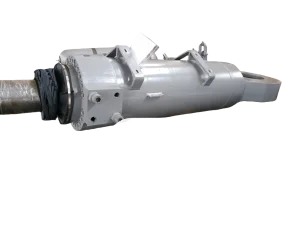
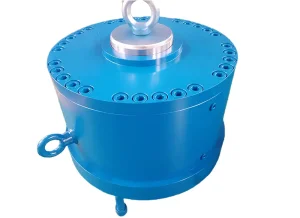
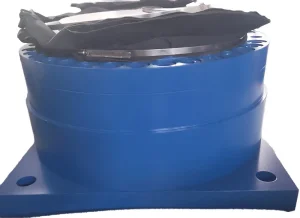
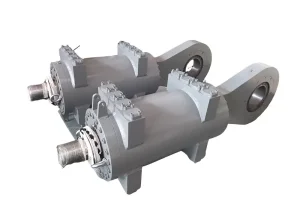
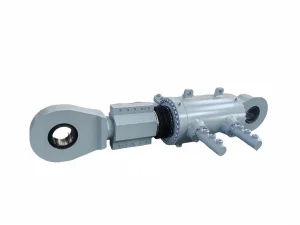
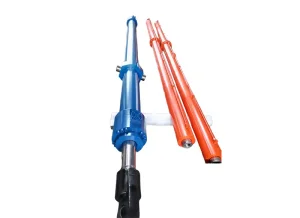
Explore our comprehensive lineup of replacement and custom-engineered cylinders for international machinery installations.
Expert engineering answers regarding design selection, maintenance, troubleshooting, and global sourcing from China exporters.
