Understanding the fluid dynamics, equal working surface geometry, and load-balancing mechanics of double-rod hydraulic cylinders.
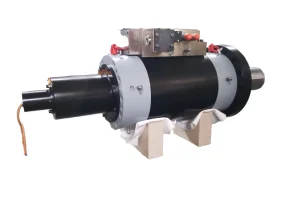
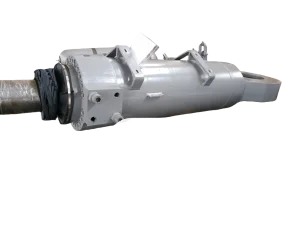
In heavy-duty fluid power engineering, a Double Rod Hydraulic Cylinder (frequently designated as a through-rod or double-ended linear actuator) represents a specialized mechanical architecture where the piston rod extends through both head and cap ends of the pressure barrel. Unlike conventional single-rod hydraulic cylinders—which exhibit asymmetrical surface areas resulting in unequal forces and speeds during extension versus retraction—the double rod design establishes perfect mechanical symmetry across both working chambers.
When pressure ($P$) is applied to either port, the effective fluid area ($A_{eff}$) remains identical:
Equal Surface Area Formula: $A_1 = A_2 = \frac{\pi}{4} \cdot (D_{bore}^2 - d_{rod}^2)$
Where $D_{bore}$ is the internal cylinder barrel diameter and $d_{rod}$ is the external rod diameter. Consequently, push force ($F_{push}$), pull force ($F_{pull}$), extension velocity ($v_{ext}$), and retraction velocity ($v_{ret}$) are mathematically identical for any given volumetric flow rate ($Q$) and operating pressure ($P$).
This equal-displacement characteristic eliminates flow imbalance in closed-loop hydraulic circuits, simplifying electro-hydraulic servo valve matching and reducing pressure spikes during rapid directional reversal. Furthermore, having two points of rod support through dual-gland guide bushings exponentially enhances structural resistance against lateral side loads and bending moments, effectively extending internal seal life under punishing industrial operating profiles.
Delivers perfectly symmetrical linear motion profiles, eliminating control algorithm complexity in automated industrial machinery and servo loops.
Dual rod gland bearings distribute non-axial loads over an expanded mechanical baseline, drastically mitigating rod flexure and barrel scoring.
Optimized internal fluid passages and low-friction dynamic seals facilitate continuous high-frequency cycling without thermal fluid breakdown.
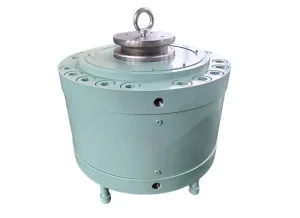
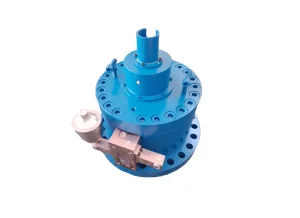
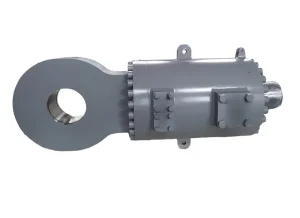
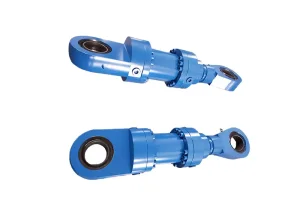
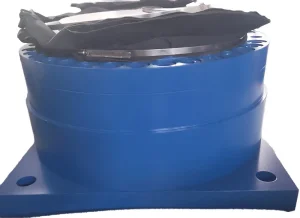
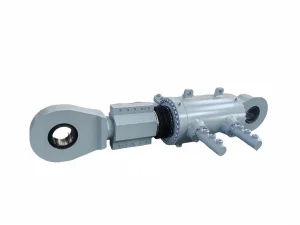
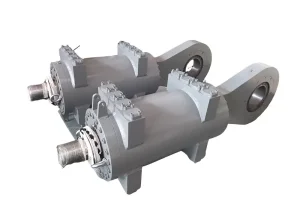
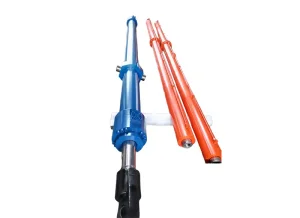
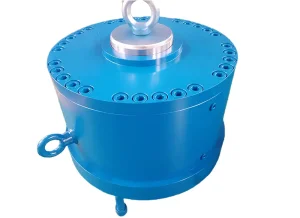
Precision-engineered replacement and OEM double rod actuators for cement machinery, vertical mills, and high-load industrial applications.
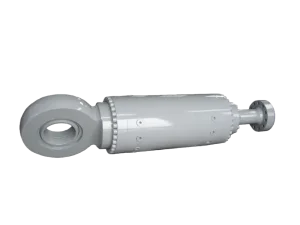
Examining the international market dynamics, operational challenges, and strategic reliance on double-rod hydraulic linear actuators across heavy industries.
The global industrial fluid power sector has witnessed a structural shift toward high-precision, heavy-duty linear actuation driven by green transition mandates, plant automation, and the scaling of mineral extraction and infrastructure processing. Within this macro environment, double rod hydraulic cylinders occupy a vital position in applications where mechanical asymmetry compromises process repeatability or machinery structural integrity.
In modern cement manufacturing facilities, raw material grinding, clinker burning, and finish grinding operate on continuous 24/7 schedules under intense abrasive dust and elevated ambient temperatures. Hydraulic thrust roller systems for rotary kilns, harrow mechanisms for stacker-reclaimers, and tensioning systems for vertical roller mills (such as Loesche LM, FLSmidth ATOX, Pfeiffer MPS, and UBE UM) demand actuators capable of absorbing severe dynamic shock loads. Double-rod cylinders provide symmetrical dampening forces, keeping grinding rollers in perfect balance and preventing mill shell deformation.
Hot and cold strip steel rolling mills utilize double rod actuators extensively within Automatic Gauge Control (AGC) systems and hydraulic loopers. The symmetrical fluid displacement of double rod designs enables real-time, sub-millimeter gap adjustment under rolling forces exceeding several thousand kilonewtons. Any force disparity between extension and stroke would cause lateral strip deviation, resulting in thickness variations or costly sheet cobbles.
Dual-rudder marine steering gear, container gantry crane steering linkages, and underground mining articulators rely on double rod double-acting hydraulic cylinders for proportional turning response. In marine applications, symmetrical hydraulic output ensures identical port and starboard helm responsiveness, which is essential for vessel stabilization and automated dynamic positioning systems.
| Kinematic / Engineering Parameter | Single Rod Hydraulic Cylinder | Double Rod Hydraulic Cylinder | Engineering Benefit of Double Rod Design |
|---|---|---|---|
| Working Area Geometry | Asymmetrical ($A_{head} \ne A_{rod}$) | Symmetrical ($A_1 = A_2$) | Equal force & speed in both motion vectors |
| Fluid Displacement Rate | Differential ($V_{ext} > V_{ret}$) | Balanced ($V_1 = V_2$) | Eliminates reservoir sizing imbalance & hydraulic shock |
| Bending Moment / Side Load Support | Single gland bearing support baseline | Dual gland bearing extended baseline | Exponentially higher resistance to column buckling |
| Control Algorithm Integration | Requires non-linear gain compensation | Linear transfer function ($G(s)$) | Simplified closed-loop electro-hydraulic servo tuning |
| Position Transducer Mounting | Requires internal gun-drilled rod | External or internal mounting on rear rod end | Simplified sensor maintenance without opening pressure fluid |
How Chinese specialized manufacturers leverage integrated supply chains, precision metallurgy, and lean production to deliver unmatched TCO value globally.
Over the past two decades, China—specifically the Changzhou and Jiangsu industrial manufacturing corridors—has established itself as the global epicenter for heavy hydraulic cylinder design and exporter services. Global EPC procurement directors and OEM machinery builders increasingly turn to Chinese manufacturers not merely for cost competition, but for deep engineering expertise, rapid prototype execution, and rigorous compliance with international quality standards (ISO 9001:2015, ISO 10100, and DIN EN 10204 3.1).
Direct integration with Tier-1 steel mills provides high-tensile seamless honed tubes (E355, ST52, 42CrMo, 35CrMo) with certified chemical compositions and ultrasonic flaw detection.
Imported German and Japanese 5-axis machining centers and deep-hole skiving machines achieve internal bore roughness $Ra < 0.1 \mu m$ and straightness tolerances within $0.03 mm/m$.
Custom dual-layer hard chrome plating ($25\text{--}50 \mu m$) and High-Velocity Oxygen Fuel (HVOF) laser cladding withstand severe abrasive dust, marine spray, and chemical exposure.
In-depth technical breakdown of how double-rod cylinders solve severe mechanical challenges across critical plant machinery.
Rotary kilns represent the thermal heart of cement production. As the massive cylindrical kiln shell rotates under extreme temperatures, axial expansion and gravity cause continuous downward slippage along its inclined axis. Hydraulic thrust roller systems utilize specialized double-acting hydraulic cylinders to push the kiln assembly slowly up and down along its supporting rollers, ensuring even wear across the tire and trunnion surfaces.
By employing custom double rod hydraulic cylinders, the thrust system maintains symmetrical fluid resistance, preventing sudden hydraulic surges when kiln thermal movement changes direction. The dual-end rod seal arrangement incorporates multi-stage Fluorocarbon (FKM) wiper rings and secondary bronze-filled PTFE step seals capable of operating continuously in ambient heat exceeding +180°C.
In high-pressure grinding roll (HPGR) applications—such as those engineered by Chengdu Leejun, CITIC Heavy Industries, or Hefei Cement Research Institute (HCRI)—hydraulic cylinders deliver static crushing pressures up to 35 MPa to fracture raw clinker or iron ore. The movable roller undergoes violent vibration and sudden shock loading whenever ungrindable tramp iron passes through the gap.
Double rod hydraulic cylinders engineered for roller presses incorporate diamond-shaped or flanged heavy mounting profiles along with hydrostatic balance oil passages. This layout prevents binding under severe angular deflection while equalizing backpressure during emergency relief valve blow-off, protecting the main press frame from fatigue cracking.
In modern industrial test benches, aerospace motion simulators, and hydro-turbine governor controls, linear actuators must execute high-frequency positioning with sub-micron repeatability. Double rod servo cylinders are the gold standard for these applications because the equal oil volume in both chambers maintains a constant dynamic natural frequency ($\omega_n$) regardless of piston position:
Hydraulic Natural Frequency: $\omega_n = \sqrt{\frac{4 \cdot \beta_e \cdot A_{eff}^2}{V_t \cdot M_t}}$
Where $\beta_e$ is the effective fluid bulk modulus, $V_t$ is total trapped oil volume, and $M_t$ is moving mass. Because $A_{eff}$ and $V_t$ remain constant in a double rod cylinder, the control transfer function does not vary across the stroke, allowing ultra-high servo loop gain tuning.
Emerging developments in smart sensing, green surface coatings, zero-leakage clearance seals, and electro-hydraulic hybrid systems.
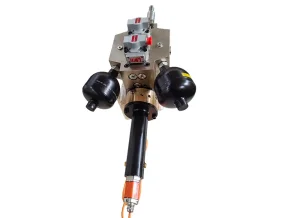
Integration of non-contact magnetostrictive position sensors, embedded pressure transducers, wireless oil contamination detectors, and vibration accelerometers directly inside the cylinder cap for predictive maintenance analytics.
Development of precision-matched clearance seals ($2\text{--}5 \mu m$ radial oil gap) and hydrostatic floating bearings that eliminate stick-slip friction entirely, ideal for high-speed dynamic testing rigs.
Transitioning from hexavalent hard chromium electroplating to environment-friendly Laser Cladding (NiCrBSi / Stellite carbide alloys), doubling surface wear hardness to $> 68 \text{ HRC}$.
A methodical checklist for plant engineers and procurement teams sourcing heavy-duty double rod hydraulic cylinders from Chinese exporters.
Sourcing replacement or custom hydraulic actuators for high-capital industrial assets requires thorough engineering qualification to eliminate installation misalignment, seal incompatibility, or premature barrel fatigue. When evaluating a China Hydraulic Cylinder Double Rod Exporter, technical procurement teams should enforce the following four-stage validation process:
Demand verified Euler Column Buckling Calculations ($SF \ge 3.0$) based on maximum extended stroke ($L_e$), working pressure ($P$), and mounting constraint factors (clevis, trunnion, or flange foot).
Confirm dynamic seal compound compatibility with site working fluid (HFD-U synthetic esters, mineral ISO VG 46/68, or water-glycol) across the total thermal operating envelope (-30°C to +200°C).
Verify that port locations, pin diameters, clevis widths, and overall retracted lengths match legacy OEM installation interfaces (e.g., Loesche, UBE, FLSmidth, Pfeiffer, or Leejun).
Expert responses to critical engineering and procurement queries regarding double-rod double-acting hydraulic cylinders.
Discover our fully customized hydraulic solutions engineered for global cement, metallurgical, and heavy industrial plant maintenance.
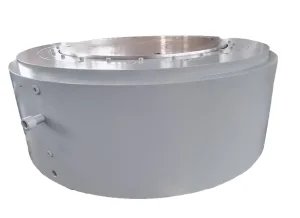
Partner with Changzhou Xuanda Hydraulic—China's premier exporter of custom double-rod double-acting actuators, vertical mill tensioning cylinders, and high-precision servo systems. Speak directly with our engineering department today.