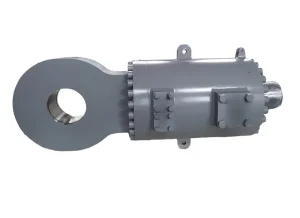
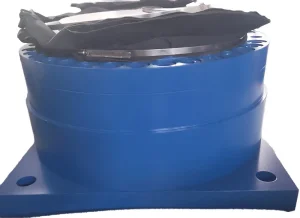
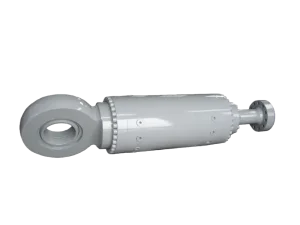
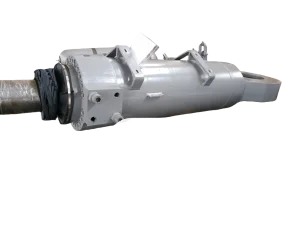
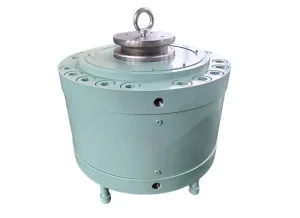
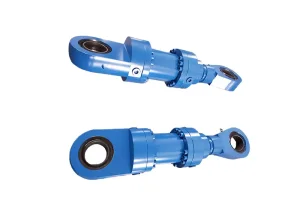
Engineered for extreme continuous duty cycles, high force-to-envelope ratios, and zero-leakage durability in raw meal grinding, clinker crushing, and heavy mechanical systems.
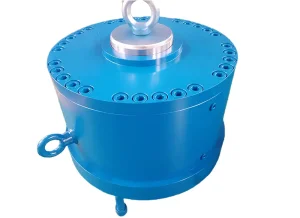
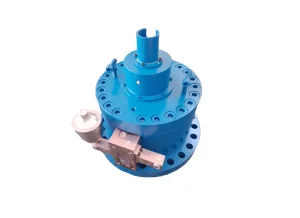
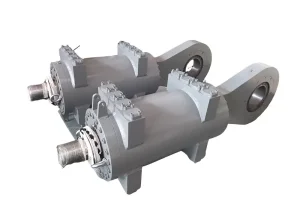
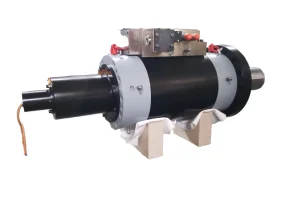
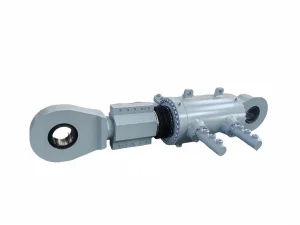
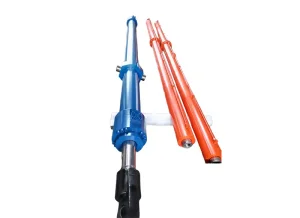
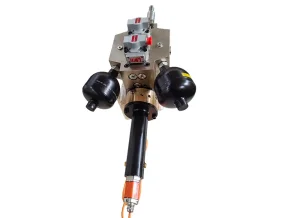
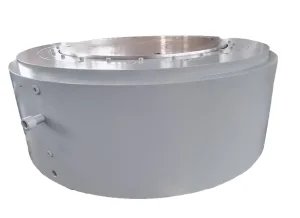
In modern heavy industry, spatial limitations often prevent the installation of larger bore single-piston actuators. Dual piston cylinders solve this constraint by utilizing tandem pressure chambers to deliver double the output force within a compact outer diameter.
By connecting two pistons in series along a common piston rod, hydraulic pressure acts simultaneously on both effective surface areas ($A_1$ and $A_2$). This architecture achieves total output thrust defined by $F_{total} = P \times (A_1 + A_2 - A_{rod})$, effectively doubling output tonnage without increasing line operating pressure.
Dual piston configurations prevent rod deflection and asymmetric wear under heavy eccentric side loading. Internal hydraulic channels equalize fluid displacement, ensuring precise velocity matching during rapid extension and retraction phases in dynamic grinding or crushing applications.
Featuring dual primary seal glands with intermediary drain ports, dual piston actuators provide exceptional zero-leakage integrity. In continuous cement mill operations, this dual barrier prevents hydraulic oil contamination into raw materials and protects internal surfaces from abrasive dust ingress.
| Performance Parameter | Standard Single Piston Cylinder | Xuanda Cost-Effective Dual Piston Cylinder | Engineering Benefit |
|---|---|---|---|
| Force Output / Envelope Ratio | Baseline (1.0x) | 1.85x – 1.95x Thrust Output | Doubles tonnage in restricted installation spaces. |
| Peak Hydraulic Working Pressure | 31.5 MPa to 40 MPa | 21 MPa to 31.5 MPa (Optimized) | Reduces pump stress, heating, and energy consumption. |
| Dynamic Side-Load Capacity | Moderate (Risk of rod scoring) | High (Dual guide ring distribution) | Prevents uneven seal wear under heavy mill shock loads. |
| Sealing Friction Coefficient | $\mu = 0.08 - 0.12$ (Standard PU) | $\mu = 0.01 - 0.03$ (Low-Friction / Clearance) | Delivers smooth, stick-slip-free servo motion control. |
| Total Cost of Ownership (TCO) | Standard maintenance cycle | 30–45% Reduction in 5-Year Maintenance | Extended seal life and reduced power unit pump sizes. |
As global industrial manufacturing prioritizes energy efficiency and equipment longevity, the commercial market for dual piston hydraulic cylinders is expanding rapidly across raw material processing, metallurgical machinery, and heavy infrastructure projects.
The transition toward high-efficiency grinding equipment in cement plants (Vertical Roller Mills and High-Pressure Roller Presses) has pushed plant operators to seek cost-effective, high-reliability actuator solutions. In the Asia-Pacific region, heavy infrastructure investments demand continuous-duty cylinders capable of withstanding intense vibration. Meanwhile, in Europe and North America, plant operators focus on replacing obsolete OEM cylinders with drop-in compatible units that deliver higher operational uptime and lower maintenance overhead.
True cost-effectiveness in heavy industrial fluid power is not merely about initial purchase price—it is measured by Total Cost of Ownership (TCO). Changzhou Xuanda Hydraulic leverages Changzhou's robust precision manufacturing ecosystem, imported German and Japanese CNC machine tools, and specialized heat-treatment processes to deliver OEM-grade dual piston cylinders at a 25–40% cost advantage compared to traditional European suppliers, without sacrificing material integrity or dimensional precision.
Dual piston cylinders are engineered to perform under severe environmental stressors—including clinker dust, extreme thermal fluctuations, continuous shock loads, and high-frequency dynamic motion.
Installed on Loesche LM, UBE UM, Pfeiffer MPS, and FLSmidth ATOX mills, dual piston tensioning cylinders apply continuous high pressure to grinding rollers. They maintain constant material bed pressure despite clinker hardness variations, reducing mill vibration and energy draw per ton of ground cement.
Used in Chengdu Leejun CLF, CITIC Heavy Industry, and HCRI roller presses. Dual piston hydraulic systems deliver rapid force adjustment to floating rollers, absorbing severe mechanical shocks when uncrushed tramp iron or hard material blocks enter the pressing gap.
In hot-strip rolling mills and continuous billet casting lines, dual piston actuators provide Automatic Gauge Control (AGC). Their rapid response frequency and high thrust allow dynamic gap adjustment within micron-level tolerances under intense thermal radiation.
Rotary kilns operate under continuous thermal axial expansion. Dual piston thrust roller cylinders maintain controlled axial positioning of the massive kiln shell, preventing ring damage and ensuring continuous clinker discharge into hydraulic-driven grate coolers.
Integrated with clearance seals or low-friction hydrostatic oil film supports, dual piston servo cylinders execute ultra-precise velocity and force control curves in high-frequency simulation test beds and precision industrial robotics.
Operating in raw material storage yards exposed to rain, dust, and freezing temperatures, dual piston harrow cylinders articulate heavy material rake mechanisms with consistent torque, ensuring smooth coal and limestone blending.
As heavy industry moves toward digital transformation, Industry 4.0 IoT integration, and zero-carbon manufacturing, Changzhou Xuanda Hydraulic is driving fluid power innovation across three key technical pillars.
Future-ready dual piston cylinders incorporate non-contact magnetostrictive linear position sensors (LVDT/SSI) and embedded micro-pressure transducers directly inside the cylinder head. This enables real-time stroke position feedback with $\pm 1 \mu m$ resolution and predictive maintenance alerting via digital plant networks.
To eliminate stick-slip friction in heavy servo applications, Xuanda has engineered hydrostatic pocket bearings within the piston and guide glands. Pressurized hydraulic oil floats the piston rod, reducing wear to near zero and extending operational life even under heavy multi-axis side loads.
Recognizing the global shift toward bio-degradable synthetic ester fluids and eco-friendly fire-resistant hydraulic media (HFC/HFD-U), our sealing matrices utilize specialized PTFE compounds and fluorocarbon elastomers (FKM/FFKM) resistant to chemical degradation at elevated temperatures.
Replacing customized, imported hydraulic cylinders during planned plant turnarounds often presents severe procurement challenges. Xuanda Hydraulic provides a full-service, drop-in replacement methodology backed by strict engineering protocols.
For plant managers operating legacy equipment without original manufacturer CAD drawings, our technical engineers execute complete dimensional mapping using 3D laser scanners and precise coordinate measuring machines (CMM). Finite Element Analysis (FEA) is performed to simulate stress concentration, rod buckling resistance under peak thrust, and seal wear dynamics before manufacturing begins.
Every dual piston cylinder manufactured at our Changzhou facility undergoes 100% pressure and leakage testing on computerized hydraulic test rigs prior to packaging. Standard test protocols include internal cross-chamber bypass leakage testing at 1.5x nominal working pressure, full-stroke velocity verification, and dynamic seal friction logging.
Technical guidance, selection advice, and operational insights from Changzhou Xuanda Hydraulic's senior engineering directorate.
A dual piston (tandem) cylinder achieves doubled force output by utilizing two pistons connected to a single rod in tandem chambers, effectively operating two force surfaces in parallel. This design allows plant operators to achieve high tonnage within a significantly smaller outer diameter (OD). The cost-effectiveness stems from three factors: (1) Lower raw material cost for smaller diameter honed tubing, (2) Compatibility with standard, smaller hydraulic power unit (HPU) valves and pumps operating at moderate pressures, and (3) Reduced structural retrofit costs when upgrading machinery in tight spaces.
Yes. Changzhou Xuanda Hydraulic has over 22 years of experience manufacturing compatible replacement cylinders for major global OEM machinery, including Loesche LM, UBE UM, Pfeiffer MPS, FLSmidth ATOX vertical roller mills, and Chengdu Leejun CLF roller presses. We guarantee identical pin-to-pin mounting dimensions, port thread specifications, stroke parameters, and force profiles. All OEM brand names mentioned are registered trademarks of their respective owners, and Xuanda operates as an independent high-precision manufacturer of compatible components.
Stick-slip motion is caused by the transition between static and dynamic friction in elastomeric seals. For high-frequency or high-precision servo applications, Xuanda utilizes either specialized low-friction PTFE bronze-filled step-seals or clearance seal technology. In clearance seal cylinders, the piston and cylinder tube are machined with ultra-tight diametrical tolerances (micrometer-level gap), allowing a controlled oil film to act as the seal with zero mechanical contact, eliminating friction and enabling linear response curves.
To prepare an accurate engineering drawing and quotation, please provide: (1) Equipment make, model, and application position, (2) Bore diameter, rod diameter, and total stroke length, (3) Nominal working pressure and peak shock pressure, (4) Mounting style (e.g., spherical clevis, trunnion, front/rear flange), (5) Fluid type (mineral oil, water-glycol, synthetic ester), operating temperature range, and environmental conditions (abrasive dust, marine humidity), and (6) Photos of the physical sample or equipment nameplate if CAD drawings are unavailable.
Hydrostatic support cylinders feature engineered fluid pockets within the internal guide bushings and piston heads. High-pressure hydraulic oil is continuously fed into these pockets, creating a stiff, pressurized fluid film that physically suspends the piston rod away from the metal guide bearings. When heavy side loads or angular deflections occur (common in roller press floating rollers), the oil film absorbs the lateral force without metal-to-metal contact, preventing barrel scoring and catastrophic seal failure.
Standard lead times for custom or OEM-replacement dual piston cylinders typically range from 25 to 40 calendar days depending on raw material forging availability and cylinder size. Emergency plant shutdown orders can be expedited. Every cylinder is subjected to 100% full-stroke hydrostatic pressure testing (1.5x working pressure), internal leakage measurement, pin alignment check, and paint thickness inspection. Comprehensive EN 10204 3.1 material test certificates and factory test reports are provided with every shipment.
Explore our specialized hydraulic cylinders for cement plants, metallurgical equipment, stacker-reclaimers, rotary kilns, and precision servo drive systems.