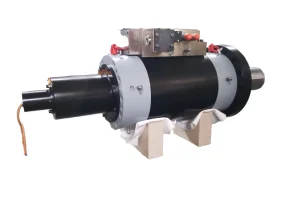
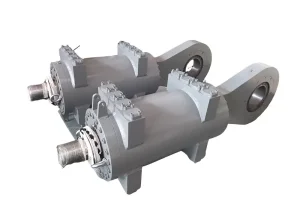
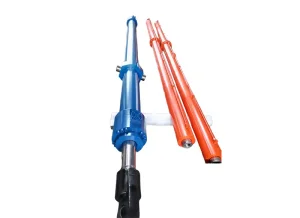
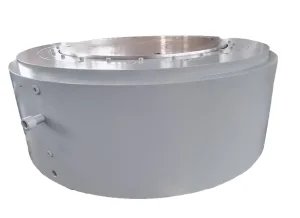
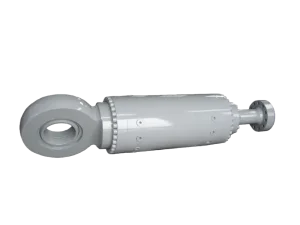
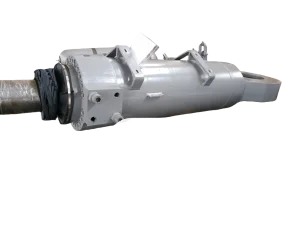
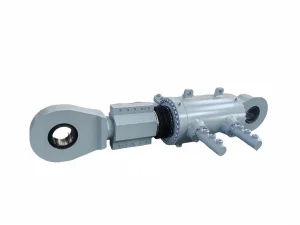
Precision-crafted hydraulic cylinders optimized for vertical roller mill pull-down tensioning, high-pressure roller press loading, and zero-leakage servo motion control.
In modern high-capacity industrial plants—ranging from cement grinding facilities and mineral beneficiation lines to heavy metallurgical rolling mills—maintaining continuous, precise, and dynamic tension force is fundamental to operational safety, machinery longevity, and thermal-mechanical efficiency. A Custom Tension Device Manufacturer must address severe operating conditions characterized by extreme shock loads, ambient dust contamination, thermal expansion cycles, and continuous high-frequency dynamic impulses.
Mechanical tensioning systems reliant solely on springs or counterweights fail to deliver the adaptiveness required by Industry 4.0 automation. Advanced hydraulic tensioning systems—built around specialized hydro-pneumatic accumulators, proportional control valves, and custom-engineered heavy-duty hydraulic cylinders—have superseded traditional designs. By constantly regulating hydraulic fluid pressures in real time, custom tension devices protect drive shafts, prevent conveyor belt slip, cushion grinding roller impacts in vertical roller mills (VRMs), and compensate for material thickness variations in high-pressure roller presses.
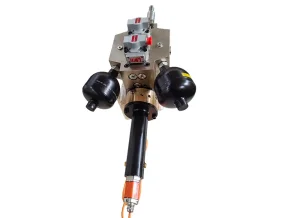
Integrated hydro-pneumatic accumulators absorb extreme surge pressure spikes within milliseconds during mill material bounces or sudden belt speed alterations, keeping structural stress within safe fatigue limits.
Engineered seal geometries, composite guide rings, and ultra-smooth honed bores prevent internal fluid bypass, eliminating unpredicted shutdown events in 24/7 continuous process industries.
100% drop-in functional compatibility with major European and Japanese OEM specifications, including Loesche, UBE, Pfeiffer, FLSmidth, Leejun, and CITIC Heavy Industries.
Analyzing procurement strategies, Total Cost of Ownership (TCO) benchmarks, and the transition toward smart digitised hydraulic actuation.
Global procurement teams across heavy industries are fundamentally reframing how they evaluate critical mechanical components. Rather than focusing solely on initial capital expenditure (CAPEX), enterprise buyers now calculate Total Cost of Ownership (TCO), prioritizing component Mean Time Between Failures (MTBF), spare-part availability, and energy efficiency. An unplanned stop on a 5,000-ton-per-day clinker production line can generate financial downtime losses exceeding tens of thousands of dollars per hour. Consequently, high-reliability custom tension devices have become a central focus for asset integrity managers worldwide.
| Parameter / Feature | Conventional Tension Device | Advanced Custom Hydraulic Tensioner | Operational Benefit |
|---|---|---|---|
| Response Time | Slow (>500 ms) mechanical lag | Ultra-fast (<20 ms) hydro-pneumatic | Immediate damping of destructive impulse loads |
| Friction Characteristic | High stick-slip friction (μ ≈ 0.15) | Ultra-low friction / Hydrostatic (μ < 0.005) | Smooth motion, zero stick-slip hysteresis |
| Force Control Accuracy | ±10% to ±15% deviation | ±0.5% closed-loop precision | Consistent material grinding / process stability |
| Service Lifetime | 12 - 18 months standard duty | 60+ months continuous heavy duty | Reduced plant maintenance costs & downtime |
| Smart Sensor Integration | External basic limit switches | Embedded SSI / Magnetostrictive LVDT | Real-time Industry 4.0 predictive maintenance |
Detailed examination of force balancing equations, accumulator sizing, rod surface engineering, and clearance sealing technology.
The design of a heavy-duty hydraulic tension device revolves around the dynamic equilibrium of applied forces. In applications like vertical roller mills (such as Loesche LM, UBE UM, Pfeiffer MPS, or FLSmidth ATOX), the hydraulic pull-down cylinder exerts a multi-ton holding force on the rocker arms to crush raw materials against the rotating grinding table.
The effective tensioning force $F_{tension}$ exerted by a single double-acting hydraulic tension cylinder is governed by fluid pressure $P_1$ acting on the bore area $A_1$, counterbalanced by annulus backpressure $P_2$ on area $A_2$ and mechanical friction force $F_{friction}$:
When uncrushable tramp iron or dynamic raw material surges pass beneath the grinding rollers, the roller lifts violently, forcing fluid out of the cylinder bore into the pre-charged nitrogen diaphragm or bladder accumulators. The transient gas compression follows the polytropic gas law equation ($P_0 \cdot V_0^\gamma = P_1 \cdot V_1^\gamma$), where $\gamma$ represents the adiabatic exponent ($\approx 1.4$ for Nitrogen gas during rapid transients). A engineered tension device balances gas volume $V_0$ and pre-charge pressure $P_0$ to prevent severe hydraulic pressure spikes ($P_{max} > 31.5 \text{ MPa}$) that could rupture seals or crack structural housings.
Sealing efficiency directly dictates control sensitivity. Changzhou Xuanda Hydraulic integrates three specialized seal configurations based on specific customer operating conditions:
Utilizes precision machining tolerances (micrometer radial clearances) between piston and cylinder bore. Eliminates elastomeric contact entirely, yielding near-zero friction, extreme thermal resistance, and infinite seal wear life for high-frequency servo tension loops.
Combines bronze or carbon-filled PTFE glide rings with elastomeric energizers. Provides exceptionally low breakaway friction ($\mu < 0.04$), preventing stick-slip chatter during minute stroke adjustments while maintaining tight fluid containment.
Forces high-pressure oil into pocket recesses along the guide bushings, floating the piston rod on an active fluid film. Designed specifically for cylinders subjected to high lateral side loads (e.g., up to 300 kN dynamic lateral forces).
How Changzhou’s advanced industrial manufacturing ecosystem delivers high-precision hydraulic cylinders with unprecedented quality control and speed.
Located in Changzhou, Jiangsu Province—the core hub of China’s heavy machinery and high-precision hydraulic equipment industry—Changzhou Xuanda Hydraulic Electromechanical Equipment Co., Ltd. exemplifies the transformation of China’s manufacturing sector under Industry 4.0 principles. Integrating advanced CAD/CAM/CAE engineering platforms with imported German and Japanese CNC machining centers, Xuanda offers global clients a unique combination of high manufacturing precision, rapid customization turnarounds, and robust supply chain resilience.
State-of-the-art CNC deep-hole boring and honing equipment produces cylinder inner bores with surface finishes down to $Ra < 0.1 \text{ }\mu\text{m}$ and roundness within $0.005 \text{ mm}$, guaranteeing long seal life and leak-free operation.
Piston rods undergo double-layer chrome plating or HVOF (High-Velocity Oxygen Fuel) thermal spraying (e.g., Chrome-Nickel or Carbide coatings), delivering surface hardness exceeding HV800 and salt-spray corrosion resistance up to 1000+ hours.
Every tension device and hydraulic actuator undergoes multi-stage pressure testing, internal leakage detection, friction force mapping, and stroke verification on computer-controlled test benches before export packing.
Furthermore, Changzhou’s mature industrial cluster ensures complete upstream raw material traceability—from high-grade forged alloy steel (42CrMo, 35CrMo, 20MnV6) to specialized seal components sourced from globally recognized seal partners. This vertical integration protects international buyers against global logistics bottlenecks and lead-time delays.
Tailored hydraulic tensioning solutions optimized for heavy machinery across raw material processing and continuous manufacturing lines.
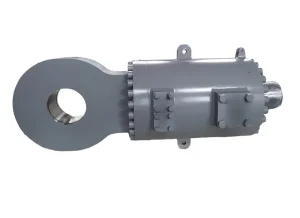
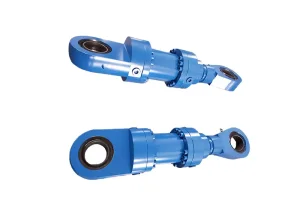
In grinding mills such as Loesche LM, UBE UM, Pfeiffer MPS, and FLSmidth ATOX, our pull-down tension cylinders apply steady, high-pressure forces to grinding rollers. Designed with integrated spherical rod ends and self-aligning bearings to accommodate roller assembly tilting without inducing bending moments on the piston rod.
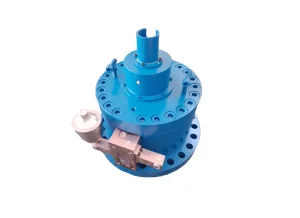
For cement clinker and mineral roller presses manufactured by Chengdu Leejun, HCRI, or CITIC Heavy Industries, hydraulic cylinders must supply tremendous pressing forces (up to 35 MPa working pressure). Specialized diamond-profile cylinders allow compact frame installation while supporting dynamic gap regulation between moving rollers.
Rotary kiln hydraulic thrust roller cylinders continuously adjust the axial position of heavy rotating kilns to ensure uniform wear on support rollers. In grate coolers, hydraulic drive actuators drive high-frequency clinker transport grates in high-temperature, high-dust environments.
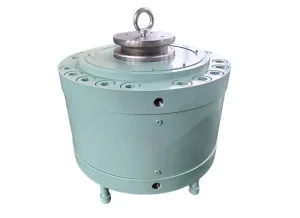
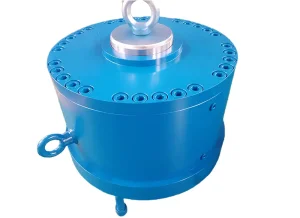
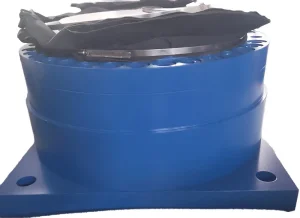
Explore our compatible range of custom hydraulic cylinders designed for OEM replacement across global industrial facilities.
Key steps and operational parameters procurement managers must evaluate prior to ordering custom tension cylinders.
Verify mounting center distances, pin eye diameters, clevis widths, port thread standards (ISO 1179 / SAE flange), and stroke limits against OEM machinery assembly drawings.
Specify nominal operating pressure (typically 16-25 MPa) alongside transient spike limits (up to 31.5 MPa or higher) to ensure cylinder tube yield strength safety margins exceed 2.5:1.
Assess ambient conditions. High thermal exposure (>100°C) demands Viton/FKM compound seals, while abrasive clinker dust requires double-lip polyurethane wiper systems with metal cages.
Authoritative answers from our senior engineering team regarding custom hydraulic tensioning devices and OEM replacements.
Yes. Our engineering department specializes in reverse engineering worn or obsolete hydraulic tension devices. By utilizing high-precision portable 3D laser scanners, nameplate parameter analysis, and physical dimensional mapping on site, we generate accurate CAD models. We verify all mounting geometry, fluid porting, and pressure ratings with your engineering team prior to machining.
Clearance seal cylinders replace physical rubber or polyurethane elastomeric contact seals with micro-gap precision sliding fits (typically 5 to 15 microns radial clearance). Because there is no elastomeric friction against the cylinder wall, breakaway friction is practically zero. This enables the servo system to make micro-adjustments with sub-micron positioning accuracy, entirely eliminating stick-slip oscillations in high-frequency tension loops.
Over 22+ years of specialized production for the cement and mineral processing sectors, we have built a extensive database of OEM mounting standards and working parameters for mills including Loesche LM series, UBE UM series, Pfeiffer MPS, FLSmidth ATOX, and TCD/TRM models. Our custom hydraulic cylinders match original pin diameters, mounting clevis dimensions, stroke lengths, and port locations, guaranteeing immediate drop-in replacement during plant overhauls.
Every manufactured hydraulic cylinder undergoes comprehensive testing according to ISO 10100 standards. Protocols include: (1) Full proof pressure testing at 1.5× working pressure, (2) Internal bypass leakage testing across extended hold periods, (3) Friction force profiling across full stroke length, (4) Ultrasonic non-destructive weld testing, and (5) Rod plating thickness and salt-spray corrosion verification.
In heavy equipment subjected to high side loads (such as roller presses or large grinding mill rocker arms), traditional guide bushings experience localized mechanical metal-on-metal contact, causing galling and seal failure. Hydrostatic support systems feed pressurized hydraulic oil directly into micro-recesses along the guide bushing, creating an active fluid film that floats the piston rod. This fluid film absorbs lateral loads up to 300 kN without physical contact, dramatically extending service lifetime.
Consult directly with our engineering team in Changzhou to review your application specifications, reverse-engineer legacy units, or optimize your machine's hydraulic tensioning system performance.