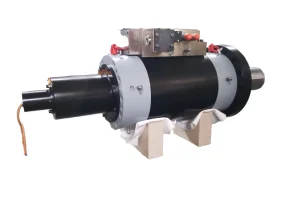
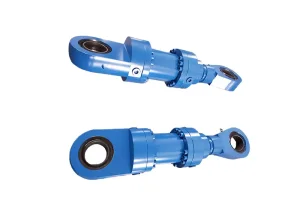
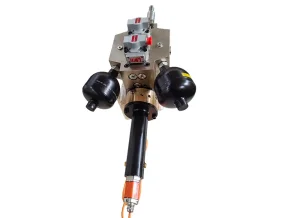
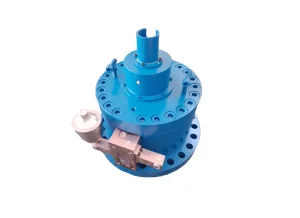
Engineered to exact OEM specifications, featuring high dynamic response, zero-leakage profiles, and extreme structural rigidity for demanding cement mill and metallurgical installations.
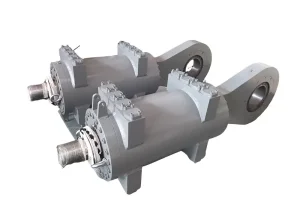
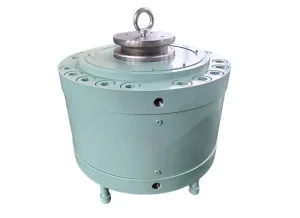
Analyzing high-power-density fluid power actuation versus electromechanical alternatives in severe duty cycles.
In heavy industrial processing—ranging from high-tonnage cement vertical roller mills to precision metallurgical rolling lines—motion control actuators are required to perform under extreme lateral loads, ambient thermal shocks, and persistent particulate contamination. While electromechanical screw drives have expanded into light-duty applications, high-dynamic Ultramotion Servo Cylinders remain the undisputed standard where power density, stiffness, and micro-second response rates are non-negotiable.
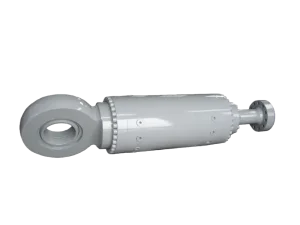
Modern industrial automation demands closed-loop motion control capable of sub-millimeter positioning accuracy combined with dynamic force control exceeding hundreds of kilonewtons. Electro-hydraulic servo cylinders meet these criteria by pairing high-pressure hydraulic oil dynamics with real-time digital position and pressure feedback transducers.
The primary barrier to ultra-precise positioning in hydraulic cylinders is the Stribeck effect—specifically static friction (breakaway force) versus kinetic friction during velocity reversals. Traditional elastomer seals create non-linear damping profiles that introduce position hunting, hysteresis, and thermal degradation in closed-loop servo systems.
Custom Ultramotion Servo Cylinder Manufacturers overcome these physical limitations through structural innovations including hydrostatic oil film bearings, clearance seal geometry, and engineered PTFE-bronze matrix sealing bands. These technologies reduce breakaway friction to near-zero levels, enabling continuous frequency responses up to 50 Hz with position repeatability down to ±1 µm.
A comprehensive analysis of hydrostatic bearings, non-contact feedback integration, and manifold fluid dynamic optimization.
Hydrostatic support cylinders utilize pocketed oil chambers machined directly into the guide sleeves. High-pressure oil is continuously supplied through calibrated capillary restrictors, establishing a constant oil film (15 µm to 30 µm thickness) between the piston rod and bearing housing.
To eliminate mechanical backlash inherent in external linkages, Ultramotion servo cylinders feature internal gun-drilled piston rods housing high-resolution magnetostrictive position transducers or optical encoders.
Fluid compression inside connecting hoses introduces capacitive hydraulic delays that reduce system bandwidth. Custom servo cylinders feature close-coupled subplate manifolds mounted directly onto the cylinder barrel.
Engineering Note: Selecting the proper clearance seal gap requires finite element thermal-expansion modeling (FEA). At operating temperatures exceeding 80°C, differential expansion between the alloy steel barrel and bronze piston matrix must be maintained within a 0.008 mm tolerance window to avoid fluid bypass or mechanical seizure.
| Sealing Architecture | Friction Coefficient ($\mu$) | Max Velocity (m/s) | Internal Leakage Rate | Ideal Application Scenario |
|---|---|---|---|---|
| Hydrostatic Oil Film Bearing | 0.0005 – 0.001 | Up to 4.0 m/s | Controlled Bypass (Continuous return path) | High-frequency test rigs, structural fatigue testing, continuous casting oscillation. |
| Precision Clearance Seal | 0.001 – 0.003 | Up to 3.0 m/s | Ultra-low micro-meter bypass | High-speed positioning loops, flight simulators, sub-millimeter servo actuators. |
| Low-Friction Composite Ring (PTFE) | 0.03 – 0.05 | Up to 1.5 m/s | Zero static leakage | Cement vertical roller mills, roller presses, metallurgical AGC systems. |
| Standard Polyurethane Elastomer | 0.10 – 0.15 | Up to 0.5 m/s | Zero static leakage | General industrial actuation, holding clamps, non-servo duty cycles. |
Empowering heavy equipment manufacturers and plant operators with custom, drop-in replacement and OEM servo cylinders.
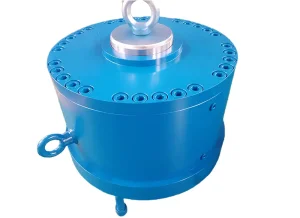
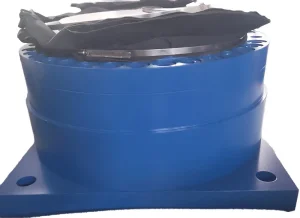
In raw material and clinker grinding, vertical roller mills (VRMs) and high-pressure roller presses (HPRPs) rely on hydraulic cylinders to apply forces exceeding several meganewtons onto rotating grinding tables. Oscillating feed rates create severe dynamic force fluctuations.
Custom hydraulic cylinders engineered for brands such as Loesche (LM Series), FLSmidth (ATOX Series), UBE (UM Series), Pfeiffer (MPS Series), and Chengdu Leejun (CLF Series) absorb dynamic shocks while holding precise pressure setpoints via high-flow accumulator networks.
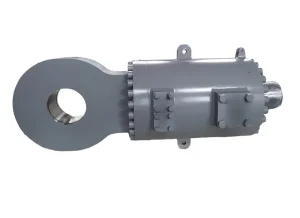
In modern steel production, Automatic Gauge Control (AGC) hydraulic cylinders govern the gap between mill rolls to achieve consistent strip thickness tolerances. These actuators require continuous high-frequency response under full rolling load.
Ultramotion servo cylinders designed for metallurgical duty feature internal displacement transducers, special flame-resistant fluid seals (HFC/HFD-U), and heavy-wall forged steel barrels designed to endure millions of load cycles under severe radiation heat exposure.
From reverse engineering damaged field units to commissioning multi-axis digital servo hydraulic systems.
Our engineering team performs complete dimensional, pressure profile, and fluid chemistry audits—including reverse-engineering worn OEM units directly on-site.
Stress concentrations, rod buckling safety margins (Euler Column formulas), and fluid velocity profiles are calculated using 3D CAD/CAE finite element software.
Cylinder barrels undergo deep-hole drilling, precision honing to Ra < 0.1 µm, and hard chrome plating or HVOF thermal spray coating on CNC grinding centers.
Every unit undergoes full-pressure static holding tests, step-response dynamic profiling, internal leakage measurement, and sensor calibration prior to export.
Ensuring full interchangeability and compliance with international fluid power design codes.
Custom actuators are designed to strict international envelope dimensions, including ISO 6020/2 (compact series), ISO 6022 (heavy-duty mill series), DIN 24333, and NFPA fluid power mounting styles (flange, trunnion, clevis, and foot mounts).
All load-bearing raw materials—including 42CrMo4 forged steel barrels, 316L stainless rods, and ductile iron glands—are supplied with original Mill Test Reports (MTR) detailing chemical analysis, tensile testing, and ultrasonic non-destructive testing (NDT).
For explosive ambient zones (hazardous powder or mining atmospheres), cylinders are furnished with ATEX-certified position feedback instruments. Test oil cleanliness is strictly controlled to ISO 4406 15/13/10 (NAS Class 6) before factory release.
Bridging conventional fluid power with digital intelligence, predictive maintenance, and self-contained hydraulic circuits.
The next generation of Ultramotion Servo Cylinders integrates embedded condition-monitoring sensor suites directly within the cylinder gland and barrel shell. Micro-sensors track rod vibration spectra, internal fluid bypass, seal temperature gradients, and particle counts in real time.
Data is transmitted via IO-Link or Edge-MQTT gateways into central plant SCADA systems, enabling predictive maintenance algorithms to alert technicians before catastrophic seal failure occurs.
Electro-Hydrostatic Actuators merge the flexibility of electric servo motors with the power density of traditional hydraulic cylinders. By connecting a variable-speed servomotor directly to a bi-directional hydraulic gear pump on the cylinder body, central hydraulic power units (HPUs) and long piping networks are completely eliminated.
EHA systems reduce total electrical energy consumption by up to 70% by drawing energy only during active movement, while completely removing oil leakage pathways associated with traditional fluid lines.
Expert engineering responses to critical questions regarding hydraulic cylinder specification, seal selection, and replacement compatibility.
Explore our complete range of engineered hydraulic cylinders for stacker-reclaimers, rotary kilns, vertical mills, and low-friction dynamic applications.