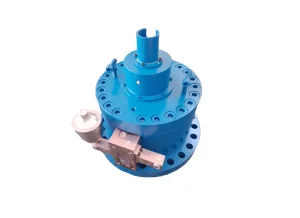
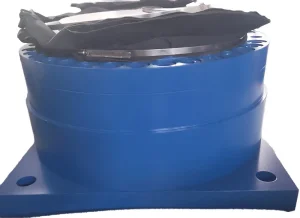
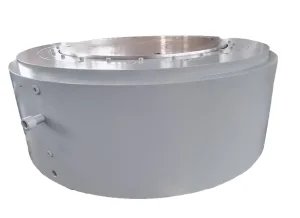
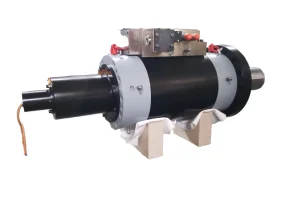
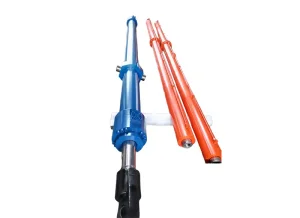
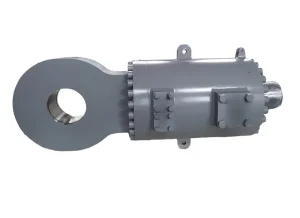
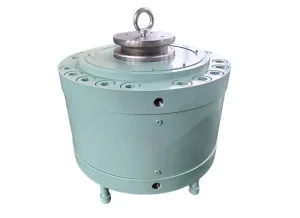
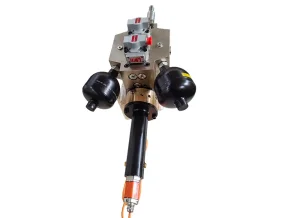
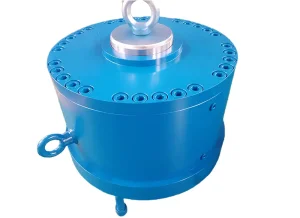
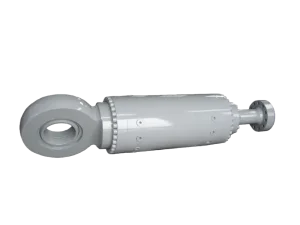
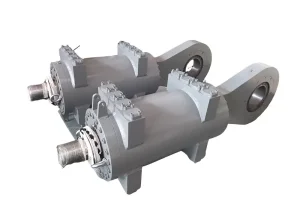
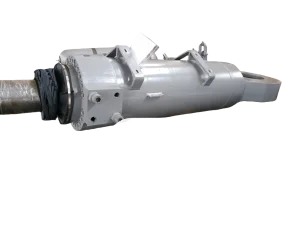
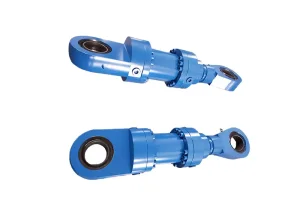
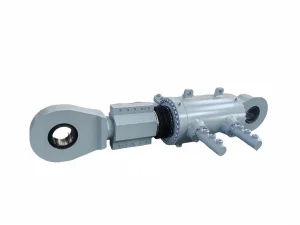
Precision-manufactured hydraulic cylinders designed for heavy industrial grinding, cement mills, roller presses, continuous casting, and high-frequency servo motion loops.
Analyzing fluid power energy conversion efficiency, mechanical advantage formulas, and the global transition toward ultra-high-pressure hydraulic systems in 24/7 continuous process industries.
In modern industrial hydraulic actuation, energy transfer relies on Pascal’s principle where pressure applied to an enclosed fluid is transmitted undiminished. Premium single-acting and double-acting cylinders convert hydraulic pressure ($P$) across bore areas ($A$) into linear mechanical output ($F = P \times A$). Designing high-pressure cylinders operating at 31.5 MPa to 70 MPa requires stringent volumetric strain modeling to prevent cylinder barrel expansion and seal bypass under extreme load surges.
For long-stroke industrial cylinders subjected to heavy compressive forces, long-column safety is paramount. Engineers calculate critical buckling loads ($P_{cr}$) using Euler's column formula: $P_{cr} = \frac{\pi^2 E I}{(K L)^2}$. Advanced cylinder designs incorporate step-tapered piston rods, high-yield alloy steels (such as 42CrMo4 and 20MnV6), and integrated guide rings to withstand extreme lateral side-loads without rod deflection or seal binding.
In high-vibration equipment such as roller presses and vertical mills, hydraulic cylinders endure severe transient pressure spikes up to 1.5× working pressure. High-quality single and double-acting cylinders incorporate proportional internal cushioning chambers, anti-cavitation check valves, and low-friction polymeric seals that dissipate hydraulic shock waves, eliminating diesel-effect oil degradation and micro-pitting on cylinder internal bores.
Selecting between single-acting and double-acting hydraulic cylinders requires evaluating force symmetry, oil flow dynamics, directional control valve topology, and system power density.
Single-acting cylinders generate hydraulic force in only one direction (extension or retraction). The opposing stroke is powered by gravity, mechanical return springs, or external structural loads.
Double-acting cylinders feature fluid ports at both head and cap ends. Fluid pressure is applied alternately to drive the piston in both extend and retract directions, granting absolute control.
| Performance Parameter | Single-Acting Cylinder | Double-Acting Cylinder | Xuanda Engineering Advantage |
|---|---|---|---|
| Hydraulic Fluid Ports | 1 Port (Extension or Retraction) | 2 Ports (Head & Cap Ends) | SAE Flange & ISO 6149 threads with leakage-free sealing |
| Directional Force Control | Unidirectional Thrust Only | Bidirectional Active Thrust & Pull | Precision-balanced fluid channels for zero pressure lag |
| Return Mechanism | External Mass / Spring / Gravity | Hydraulic Fluid Pressure | High-fatigue chrome-silicon internal springs or dual hydraulic power |
| Control Loop Capability | Open-loop Positioning / Clamping | Closed-Loop Servo (Position & Force) | Compatible with magnetostrictive sensors for ±1 µm position control |
| Seal Wear Characteristics | Lower seal wear (Single dynamic seal) | Dual dynamic seals (Piston & Rod) | Low-friction PTFE matrix with elastomeric energizers |
| System Energy Footprint | Minimal pump displacement needed | Continuous fluid circulation required | Optimized differential area ratios for reduced pump power draw |
| Mainstay Applications | Lifting tables, Kiln thrusts, Dumpers | Vertical Mills, Roller Presses, AGC Systems | Custom drop-in replacements for Loesche, UBE, Leejun, Pfeiffer, FLSmidth |
Manufacturing world-class hydraulic cylinders demands rigorous alloy selection, precision deep-hole honing, and specialized surface coatings to withstand aggressive abrasive dust and extreme operating temperatures.
Xuanda utilizes German and Japanese CNC skiving and roller burnishing equipment to achieve internal barrel surface roughness of Ra < 0.1 µm and dimensional tolerances up to ISO H7/H8. Seamless honed tubes made of St52-3, E355, or 27SiMn undergo ultrasonic flaw detection to eliminate micro-inclusions, ensuring zero pressure drop across high-pressure piston seals.
Piston rods engineered from 42CrMo4 high-tensile forged steel receive 30–50 µm hard chrome plating (surface hardness > 850 HV) or specialized HVOF thermal spray coatings (Cr3C2-NiCr / WC-Co-Cr). This imparts extreme corrosion resistance capable of withstanding > 1000 hours of neutral salt spray testing (ISO 9227) in marine and clinker dust environments.
For high-frequency servo applications, conventional rubber seals introduce stick-slip friction. Xuanda’s proprietary Clearance Seals and Hydrostatic Support Bearings float the piston and rod on a pressurized 15–25 µm oil film. This eliminates mechanical contact, yielding near-zero friction coefficient ($\mu < 0.001$) and extending seal service life up to 10×.
Xuanda hydraulic cylinders serve as direct, drop-in replacement units and OEM initial equipment for cement plants, steel rolling mills, power plants, and marine engineering systems worldwide.
In cement raw meal, slag, and coal grinding circuits, vertical mill cylinders maintain immense pressure on grinding rollers. Compatible with Loesche LM, UBE UM, Pfeiffer MPS, FLSmidth ATOX, and TCD/TRM mills, Xuanda cylinders feature heavy-duty accumulator dampening interfaces that absorb severe mill bounce and grinding shock loads without losing system pressure.
Grinding raw materials requires consistent inter-particle crushing. Designed for Chengdu Leejun CLF, CITIC Heavy Industries, and HCRI roller presses, our high-pressure hydraulic cylinders (operating up to 35-40 MPa) utilize diamond-profile mounting frames and self-aligning spherical bearings to manage severe differential roller tilting during operation.
Rotary kiln hydraulic thrust rollers continuously control the axial movement of the kiln shell. Xuanda single and double-acting thrust cylinders feature high-temperature Viton/FKM seals rated up to 200°C. Meanwhile, our grate cooler cylinders drive clinker conveyor beds with high stroke frequency and dust-proof scraper wiper rings.
In steelmaking, automatic gauge control (AGC) cylinders demand high-speed responsiveness and sub-micron positioning. Xuanda servo cylinders incorporate low-friction PTFE step-seals and integrated magnetostrictive position sensors, maintaining roll gap stability under high ambient radiant heat.
Adhering to strict international quality protocols guarantees that Changzhou Xuanda’s single-acting and double-acting hydraulic cylinders exceed performance criteria across North America, Europe, Asia-Pacific, and the Middle East.
Every cylinder manufactured in our Changzhou facility complies with ISO 9001:2015 quality management systems and ISO 14001 environmental standards. For hazardous coal-grinding or offshore environments, cylinders can be certified under ATEX Directive 2014/34/EU and CE safety mandates, ensuring seamless global deployment.
Prior to shipment, 100% of Xuanda hydraulic cylinders undergo automated pressure testing on custom digital test benches. Tests include: Hydrostatic Proof Pressure (tested up to 1.5× rated working pressure), Internal Piston Bypass Leakage Verification (< 0.1 cm³/min), Friction Resistance Drag Measurements, and Full Stroke Velocity Profiling.
Exporting to over 30 countries requires robust ocean-freight packaging. Cylinders are treated with VCI anti-rust oil, sealed in moisture-proof vacuum film, and enclosed in heavy-duty IPPC-certified fumigation-free wooden cases. We provide full technical documentation including material mill test certificates (EN 10204 3.1), dimensional inspection reports, and seal origin certificates.
The future of fluid power lies in smart diagnostic connectivity, electro-hydrostatic self-contained actuation, and zero-leakage eco-friendly sealing systems.
Xuanda is pioneering smart cylinders embedded with IO-Link digital sensors. Real-time monitoring of internal pressure, fluid temperature, rod displacement, and vibration patterns enables predictive maintenance algorithms, alerting plant managers to seal wear or oil contamination before catastrophic plant failure occurs.
By coupling a variable-speed servomotor directly to a bi-directional pump and a double-acting cylinder, Xuanda's EHA systems eliminate central hydraulic power units and long piping networks. This reduces total hydraulic fluid volume by 80% while dramatically lowering electrical energy consumption.
Utilizing CAD/CAM/CAE finite element analysis (FEA) and computational fluid dynamics (CFD), our design team simulates internal fluid velocity, valve cavity turbulence, and stress distributions under peak 70 MPa impact loads, optimizing cylinder weight and thermal dissipation capability.
In-depth technical answers from Xuanda’s hydraulic engineering team to assist procurement managers and plant engineers in specifying the exact cylinder design.
Single-acting cylinders are optimal when work (force) is required in only one direction, and external forces (gravity or heavy mechanical weight) or an internal spring can reliably retract the piston rod. Examples include hydraulic platform jacks, rotary kiln thrust rollers, and stacker-reclaimer harrows. Double-acting cylinders are essential when controlled force, velocity, and precise positioning are required in both push and pull directions—such as in vertical roller mill loading, roller press gap regulation, and continuous casting AGC systems.
Yes. Our engineering team specializes in reverse-engineering legacy hydraulic cylinders. By analyzing physical worn samples, flange mounting measurements, operating pressures, nameplate data, and site photos, we generate detailed 3D CAD models and production drawings. We guarantee 100% mounting bolt-pattern and fluid-port interchangeability with original OEM components while often upgrading seal packages to modern low-friction materials.
Elastomeric rubber or polyurethane seals create physical contact friction against the cylinder bore, introducing hysteresis and stick-slip motion during micro-adjustments in servo loops. Clearance seals utilize ultra-precise machining (tolerances within 2 to 5 microns) between the metal piston and bore. Controlled micro-leakage creates a hydraulic fluid cushion, resulting in virtually zero friction, infinite seal life without elastic degradation, and exceptional response frequency suitable for high-speed dynamic testing and servo control.
To provide a rigorous engineering proposal, we recommend supplying: (1) Cylinder Bore Size and Piston Rod Diameter, (2) Total Working Stroke length, (3) Maximum Operating & Peak Pressure (MPa/Bar), (4) Mounting Interface Type (Clevis, Spherical Bearing, Front/Rear Flange, Trunnion), (5) Operating Medium (Mineral oil, Water-glycol, Synthetic ester) and Temperature range, and (6) Speed / Duty Cycle requirements.
We apply heavy hard chrome plating (minimum 30–50 µm thickness) followed by precision polishing to Ra < 0.1 µm. For extreme marine or high-acid industrial atmospheres, we utilize dual-layer Nickel-Chrome plating or High-Velocity Oxygen Fuel (HVOF) thermal spray tungsten-carbide coatings. Additionally, double-lip polyurethane wiper scrapers prevent clinker, cement dust, or grit from penetrating the primary seal cavity.
Standard custom cylinder designs typically ship within 30 to 45 days after 3D drawing approval. For emergency drop-in replacement cylinders for cement plant shutdowns, expedited manufacturing protocols can achieve dispatch within 15 to 20 days, utilizing our extensive inventory of pre-honed forged steel tubes and chrome-plated bar stock.
Explore our full line of specialized replacement cylinders for major vertical mills, press equipment, stackers, coolers, and high-frequency servo drives.