In the modern landscape of high-performance industrial equipment, particularly within Germany's manufacturing centers across North Rhine-Westphalia, Baden-Württemberg, and Bavaria, traditional contact-sealed hydraulic actuators face physical limits. Conventional elastomeric or PTFE seals generate stick-slip phenomena, dynamic friction heat, hysteresis, and mechanical wear that restrict high-frequency servo response and compromise continuous operational efficiency.
Clearance seal hydraulic cylinders represent a paradigm shift in fluid power technology. By eliminating contact sealing elements between the reciprocating piston and cylinder bore, these specialized actuators operate on an engineered hydrodynamic fluid film. Micro-gap design—engineered to precision tolerances between 3 to 8 micrometers—allows ultra-low friction, high-frequency response, near-zero breakaway force, and an extended operational lifespan even under severe continuous duty cycles.
Precision-engineered actuators designed for seamless integration into European plant equipment, cement grinding lines, and high-frequency dynamic testing environments.
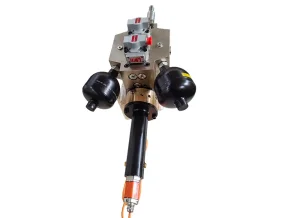
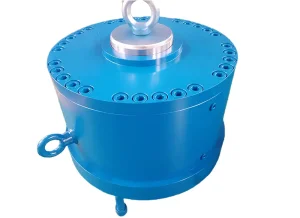
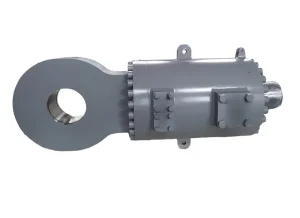
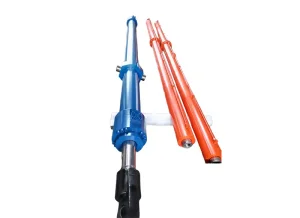
The core operating principle of a clearance seal hydraulic cylinder relies on precise hydrodynamic shear and controlled viscous leakage within an annular micro-clearance gap between the piston head and the honed cylinder barrel. Unlike conventional soft seals that physically contact the moving wall, clearance seal technology utilizes fluid dynamics principles defined by the Navier-Stokes equations and Hagen-Poiseuille law for laminar fluid motion within narrow channels.
Calculated Viscous Leakage Equation: Q = (π · d · h³ · ΔP) / (12 · μ · L) — where d is nominal bore diameter, h is radial clearance gap, ΔP is differential pressure across the piston, μ is dynamic fluid viscosity, and L is effective engagement land length. By controlling gap dimensional tolerances within micro-scale limits (IT4 to IT5 grades), volumetric leakage is held to acceptable internal recirculating rates while achieving zero dynamic contact friction.
Machined on precision German and Japanese CNC cylindrical grinding platforms, maintaining cylindrical concentricity and roundness within < 0.002 mm across full stroke length.
Absence of elastomer friction allows instantaneous acceleration, enabling closed-loop servo control systems to achieve positioning repeatability within sub-micron thresholds.
Controlled micro-leakage acts as a continuous heat dissipation channel, preventing localized thermal buildup and maintaining stable fluid viscosity during high-frequency oscillation.
| Performance Metric | Clearance Seal Actuator | Low-Friction PTFE Seal | Standard Polyurethane Seal |
|---|---|---|---|
| Static Friction (Breakaway) | Near Zero (< 0.05 bar equivalent) | Low (1.5 - 3.0 bar) | High (5.0 - 10.0 bar) |
| Dynamic Friction Coefficients | 0.0001 - 0.001 (Viscous only) | 0.03 - 0.08 | 0.12 - 0.25 |
| Stick-Slip Susceptibility | Completely Eliminated | Slight at ultra-low speeds | High at low speeds (< 10 mm/s) |
| Maximum Velocity | > 5.0 m/s | 2.0 m/s | 0.8 m/s |
| Maximum Operating Temp | Up to +250°C (All-Metal Design) | -30°C to +200°C | -35°C to +100°C |
| Expected Seal Wear Life | Infinite (No mechanical contact) | 10,000 - 25,000 Operating Hours | 5,000 - 12,000 Operating Hours |
Supporting critical production infrastructure, heavy processing equipment, and high-tech R&D facilities throughout Germany and Western Europe.
Widely deployed in Baden-Württemberg's vehicle development centers. Clearance seal cylinders drive multi-axis dynamic durability simulators operating at high frequencies (30–80 Hz) without overheating or seal degradation.
Designed for modernization projects in Ruhr region industrial plants. Used as replacement actuators in Loesche LM, UBE UM, and Polysius grinding mills to absorb transient mechanical shock loads and optimize force transfer.
Critical elements in steel manufacturing facilities around Duisburg and Saarland. Clearance seal design enables high-temperature operation directly adjacent to molten steel casting lines, providing steady sinusoidal oscillation.
Over two decades of precision fluid power innovation, export compliance, and rigorous quality assurance.
Every clearance seal cylinder produced for export to Germany undergoes rigorous non-destructive testing (NDT), ultrasonic inspection of forged components, and full pressure testing according to international standards.
Procuring hydraulic equipment for German plant installations requires exact adherence to drawing specifications, metric ports (ISO 6149 / DIN 3852), standard stroke lengths, and flange interfaces (DIN/ISO/SAE). We support German maintenance teams and original equipment manufacturers with comprehensive reverse-engineering and direct OEM replacement capabilities.
Whether you require a custom one-off replacement for a legacy press cylinder or continuous production volumes for machine tool manufacturing, our engineering department provides 3D CAD modeling (STEP/IGES format) for pre-production verification prior to metal cutting.
Explore our extended catalog of low-friction, hydrostatic support, and specialized mill cylinders engineered to OEM operational benchmarks.
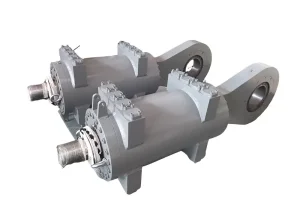
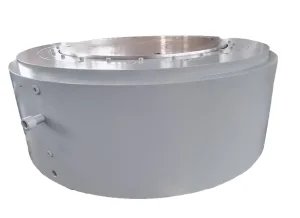
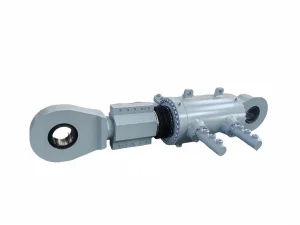
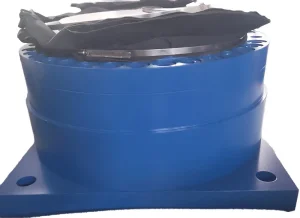
Advancing clearance seal technology with real-time diagnostic capabilities, smart fluid monitoring, and predictive maintenance infrastructure.
Embedded thermal and flow sensors measure internal recirculating oil volume continuously. Data streams directly into plant IoT networks (e.g., Siemens MindSphere) to predict pump efficiency and oil aging without operational downtime.
Internal magnetostrictive stroke sensors (SSI/Profinet interfaces) built directly within the hollowed piston rod provide non-contact absolute positioning feedback with resolution up to 0.5 μm, ideal for automated German manufacturing cells.
Applying Diamond-Like Carbon (DLC) and high-velocity oxygen-fuel (HVOF) ceramic-metallic coatings to piston lands. This technology enhances surface hardness beyond 70 HRC, eliminating scuffing risk under high peak surges.
Expert technical insights regarding selection, fluid viscosity requirements, leak rate calculations, and maintenance practices.
Clearance seal cylinders restrict flow by utilizing an ultra-tight, precision-machined radial gap (typically 3 to 8 micrometers) over a extended piston land length. Under fluid dynamics laws, fluid flow through a narrow annular slot is inversely proportional to fluid viscosity and land length, and proportional to the cube of the gap height (h³). By maintaining sub-micron gap consistency, the volumetric leakage rate is kept extremely small—acting as controlled internal lubrication rather than systemic pressure loss.
Optimal performance is typically achieved using high-grade mineral or synthetic hydraulic oils with viscosity grades of ISO VG 32, ISO VG 46, or specialized anti-wear synthetic fluids (ISO VG 68 for elevated temperature environments). Maintaining fluid cleanliness according to ISO 4406 targets of 15/13/10 or cleaner is critical to prevent solid particulate wear across the micro-clearance gap.
Yes. Xuanda specializes in reverse-engineering and manufacturing direct drop-in replacement cylinders compatible with original mounting dimensions, stroke lengths, and operating pressures of major European machinery brands, including Loesche, UBE, Polysius, and ThyssenKrupp industrial equipment. All custom cylinders match or exceed original OEM dynamic performance standards.
A clearance seal cylinder relies on hydrodynamic pressure built up by motion and small gaps to minimize seal contact. In contrast, a hydrostatic support cylinder utilizes an external high-pressure oil supply delivered directly into pocketed radial bearings surrounding the rod and piston. Hydrostatic cylinders actively float the piston on a continuous oil film even when stationary under massive lateral side loads, whereas clearance seals are simpler, passive all-metal designs ideal for high-speed dynamic oscillation.
Thermal expansion control is a fundamental element of our engineering design. Piston and barrel materials are selected with closely matched coefficients of thermal expansion (CTE). Additionally, our engineering team performs finite element thermal-structural analysis (FEA) to ensure that under maximum operating temperature differentials, the micro-gap remains within engineered design tolerances without binding or excessive leakage expansion.
Direct factory engineering consultation, customized CAD designs, export compliance for Germany & Europe, and reliable lifecycle technical support.
Send Inquiry Now