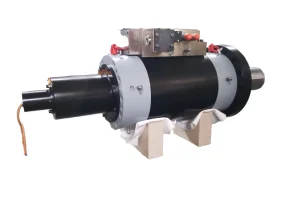
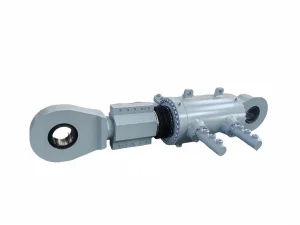
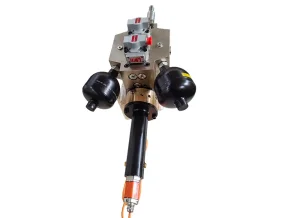
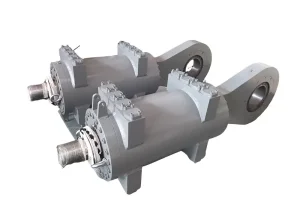
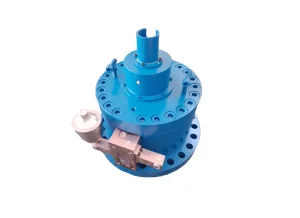
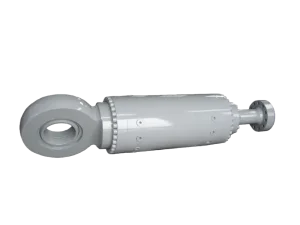
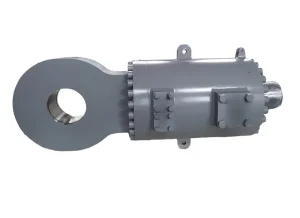
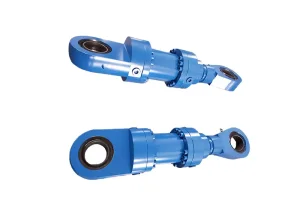
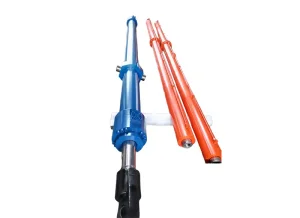
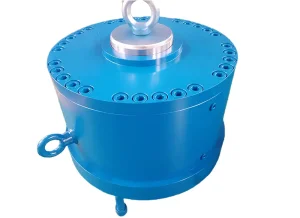
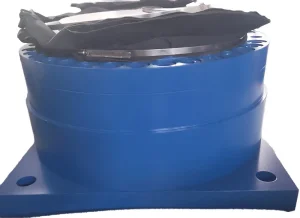
Direct OEM-compatible designs, clearance seal options, and hydrostatic support configurations engineered for heavy side-load stability, high dynamic response, and extreme service durability.
A comprehensive analysis of zero-contact oil film lubrication, tribological clearance optimization, and extreme-duty mechanical performance in modern fluid power systems.
In modern high-capacity heavy machinery—ranging from mining rock crushers and pulp mill continuous board presses to advanced sub-zero marine steering systems—traditional hydraulic actuators frequently face severe tribological boundaries. High side-loads, cyclic vibration, dynamic eccentricity, and micro-positioning requirements lead to rapid elastomer degradation, rod scuffing, stick-slip instability, and costly operational downtime. For industrial plants operating in Finland and the broader Nordic region, these challenges are further intensified by ambient temperatures dropping to -40°C, requiring exceptional fluid dynamics and metallurgy.
Hydrostatic Support Hydraulic Cylinders represent the pinnacle of fluid power bearing architecture. Unlike conventional cylinders that rely on physical contact bearings (such as bronze or polymer guide rings) and dynamic elastomer pressure seals, hydrostatic cylinders suspend the moving rod and piston assembly on a continuously pressurized micro-thin film of hydraulic fluid ($15\text{--}30\,\mu\text{m}$ thickness). By engineering multi-pocket hydrostatic bearing recesses directly into the cylinder head and piston guide structures, fluid pressure is dynamically governed by internal capillary or orifice restrictors. This continuous fluid suspension completely eliminates metallic contact, reduces friction to near zero, and yields virtually infinite operational fatigue life under heavy dynamic side-loads.
By eliminating static friction ($\mu_s \approx 0$), hydrostatic cylinders prevent stick-slip phenomena in closed-loop servo loops. This enables sub-micron stroke repeatability ($\pm 1\,\mu\text{m}$) essential for continuous press controls and high-frequency structural test rigs.
Hydrostatic pocket pressure automatically scales in proportion to radial displacement. If eccentric loads force the rod toward one quadrant, pocket pressure on that side instantly spikes, creating immense hydraulic stiffness ($K_h$) that prevents metal-to-metal contact.
Because the moving components float entirely on viscous oil layers, surface wear is virtually non-existent. Equipment lifecycles increase tenfold compared to traditional contact-sealed actuators operating under abrasive grit conditions.
Analyzing the operational environments of Tampere, Turku, Helsinki, Jyväskylä, and Kotka to engineer hydraulic systems built for Nordic excellence.
Finland hosts world-leading mining machinery engineering hubs (centered in Tampere and Turku), manufacturing primary jaw crushers, cone crushers, underground drilling rigs, and high-pressure grinding rolls (HPGR). Equipment deployed in northern mines (such as Kittilä or Kevitsa) endures heavy shock impacts and extreme abrasive mineral dust.
The Finnish forest industry—with major paper and mill complexes around Jyväskylä, Lappeenranta, and Kotka—relies on continuous 24/7 automation. Heavy de-barking drums, timber harvesters, and pulp refining presses require uniform pressure distribution under high cycle speeds.
Shipyards in Turku, Rauma, and Helsinki lead global specialized maritime construction, building Arctic icebreakers, polar research vessels, and luxury cruise ships. Steering gears, dynamic positioning thrusters, and deck crane support systems encounter severe wave slapping and sub-zero Arctic salt spray.
Winter operational conditions in Lapland reach -40°C, causing conventional nitrile or polyurethane seals to glassify, crack, and fail. Hydrostatic support systems overcome fluid viscosity spikes during cold startup through optimized pocket dimensions and secondary heating channels.
Understanding how zero-contact fluid film support compares with conventional dynamic contact seals and low-friction elastomeric cylinders.
| Performance Parameters | Standard Contact Seal Cylinder | Low-Friction Elastomer Cylinder | Hydrostatic Support Cylinder (Xuanda Tech) |
|---|---|---|---|
| Dynamic Friction Coefficient ($\mu$) | 0.05 – 0.12 (High friction) | 0.01 – 0.03 (Medium friction) | 0.0005 – 0.001 (Virtually Zero) |
| Stick-Slip Behavior | Severe at speeds < 15 mm/s | Moderate under fluctuating pressure | Completely Eliminated ($\Delta v = 0$) |
| Dynamic Side-Load Resistance | Low (Risk of rod scuffing/galling) | Moderate (Limited by guide ring yield) | Ultra-High (Absorbed by Pocket Pressure Spikes) |
| Sealing Contact Life | 3,000 – 8,000 Operating Hours | 8,000 – 15,000 Operating Hours | > 50,000 Hours (Zero Metallic Contact) |
| Sub-Zero (-40°C) Startability | High seal cracking risk | Requires pre-heating cycles | Immediate Fluid Film Clearance Support |
| Positioning Accuracy | $\pm 0.5 \text{ mm}$ | $\pm 0.05 \text{ mm}$ | Sub-micron ($\pm 0.001 \text{ mm} / \pm 1 \mu\text{m}$) |
Empowering global OEM buyers with world-class production infrastructure, rigorous quality assurance, and proven export logistics.
Why Finnish OEMs and heavy plant operators partner with Changzhou Xuanda Hydraulic to optimize total cost of ownership (TCO) without sacrificing engineering integrity.
Situated in Changzhou’s premier electro-mechanical industrial park, our plant utilizes imported German and Japanese 5-axis machining centers, 12-meter deep-hole boring tools, and Sunnen honing machines ensuring bore roundness under $2\,\mu\text{m}$ and surface roughness $Ra < 0.05\,\mu\text{m}$.
Leveraging China's complete industrial supply chain—from raw forged alloy steel billets to high-purity plating—gives Finnish buyers substantial cost advantages compared to Western European boutique hydraulic shops, with zero compromise on precision.
Every single hydrostatic support cylinder undergoes rigorous static proof testing at 1.5x nominal working pressure, dynamic frequency response analysis, and ultrasonic flaw detection (UT) per EN 10228-3 standards prior to packing.
Ensuring complete regulatory compliance, smooth customs clearance at Helsinki or Kotka, and seamless technical integration.
Xuanda Hydrostatic Cylinders are designed and manufactured strictly in according with European Union directives and international quality standards:
We provide dedicated support for Finnish procurement teams and plant engineers from technical inquiry to site installation:
Integrating real-time sensor feedback into hydrostatic bearing pockets for continuous condition monitoring in modern Finnish smart factories.
As Finnish industrial enterprises accelerate adoption of Industry 4.0 paradigms (älykäs valmistus), modern hydraulic actuators must deliver more than raw force—they must serve as intelligent feedback nodes. Xuanda Hydrostatic Support Hydraulic Cylinders can be specified with fully integrated electronic sensor suites designed for tough industrial environments:
High-resolution absolute position feedback sensors (such as MTS Temposonics or Balluff interfaces) built coaxially inside the hollow-bored cylinder rod, offering sub-millimeter stroke precision ($\pm 0.005\,\text{mm}$) impervious to high pressure.
Micro-piezoresistive pressure sensors embedded directly in each bearing recess pocket. Real-time differential pressure measurements instantly signal dynamic side-load shifts or pump pressure degradation before mechanical contact can occur.
Platinum RTD sensors monitor fluid pocket temperature, alerting maintenance staff to fluid shear overheating or oil degradation in extreme sub-zero or high-duty continuous press cycles.
Addressing engineering specifics, sub-zero oil behavior, drawing conversion, and order execution.
Traditional contact seals and guide rings generate static friction ($\mu_s$) that is significantly higher than dynamic friction ($\mu_d$). At low velocities (< 15 mm/s), this friction differential causes the actuator to jerk or "stick-slip." Hydrostatic support cylinders completely isolate moving parts on a continuous $15\text{--}30\,\mu\text{m}$ oil film pressurized by an external auxiliary pump or main pressure line throttling. Because there is zero solid-to-solid contact, static friction is eliminated ($\mu_s \approx 0$), guaranteeing perfectly smooth micro-stepping motion down to fractional millimeters per second.
Yes. We specialize in producing 100% drop-in replacement hydraulic cylinders that match original installation dimensions, port orientations, stroke limits, and operating pressure curves of leading European OEM equipment. Brand names belong to their respective owners; Xuanda engineers custom compatible components designed to meet or exceed original operational specs.
Cold ambient conditions dramatically increase hydraulic fluid viscosity. Our Nordic-spec hydrostatic cylinders utilize enlarged internal capillary restrictors calibrated for low-temperature synthetic fluids (ISO VG 32 / VG 46). Furthermore, cylinder barrels are fabricated from impact-tested fine-grain alloy steel (e.g., 42CrMo4) verified by Charpy V-notch testing at -40°C ($\ge 27\,\text{J}$), preventing brittle failure during cold pressure spikes.
A clearance seal cylinder relies on an extremely tight mechanical fit (typically $5\text{--}10\,\mu\text{m}$ clearance) between piston and barrel without elastomeric seals, relying on controlled fluid leakage to minimize friction. However, clearance seal cylinders have limited side-load tolerance. A hydrostatic support cylinder, by contrast, incorporates active pressurized recess pockets. When side-loads force the rod off-center, pocket pressure dynamically increases on the loaded side, generating powerful hydraulic restoring forces to support massive dynamic side-loads.
Yes. Our engineering division routinely performs complete reverse-engineering. You can provide physical dimensions, nameplate photos, or ship the worn unit to us. We will generate comprehensive 3D CAD models, confirm porting and mounting configurations with your engineering team, and proceed to CNC manufacturing only after your full approval.
Every shipment includes a comprehensive Quality Dossier: EN 10204 3.1 Material Test Certificates (MTC) verifying raw material chemical composition and mechanical properties, 100% Hydrostatic Pressure Test Certificates, Chrome Plating Thickness & Salt Spray Test Reports, Ultrasonic Inspection Reports, and CE Declaration of Conformity.
Standard custom engineering production cycles range from 4 to 6 weeks depending on cylinder bore size and stroke complexity. Express ocean freight to Port of Vuosaari or Kotka takes approximately 28–35 days, while emergency replacement orders can be dispatched via air freight directly to Helsinki-Vantaa Airport (HEL) within 5–7 days after factory testing.
Explore our specialized range of vertical roller mill tensioners, roller press cylinders, grate cooler actuators, and stacker-reclaimer hydraulics available for export to Finland.
Partner with Changzhou Xuanda Hydraulic Electromechanical Equipment Co., Ltd. for custom sub-zero hydrostatic cylinders, OEM replacements, and advanced fluid power engineering tailored for Finnish heavy industry.
Send Inquiry Now