Directly engineered for severe duty cycles, extreme side loads, and micro-positioning precision in Swedish industrial plants.
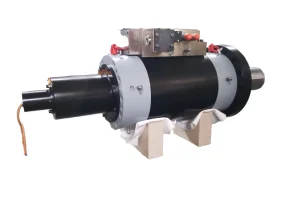
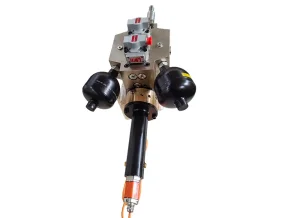
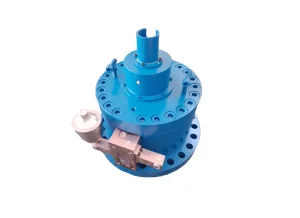
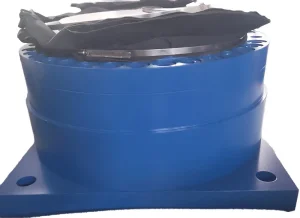
As Swedish manufacturing spearheads green steel initiatives, subterranean mineral extraction, and high-efficiency forestry engineering, heavy machinery hydraulic systems must transcend conventional mechanical wear limits.
In Kiruna, Malmberget, and the Skellefte field (operated by LKAB and Boliden), heavy crushing equipment and subterranean drilling rigs operate under extreme shock loads. Hydrostatic support cylinders withstand intense lateral vibrations without risk of cylinder barrel scoring or catastrophic seal degradation.
Sweden’s pioneering transition toward fossil-free steel (HYBRIT and H2 Green Steel initiatives in Boden/Luleå) requires continuous casting lines and electric arc furnaces capable of millimetric positioning under immense thermal gradients and intense side forces, where elastomeric seals fail prematurely.
Operating in Northern Sweden demands hydraulic actuators capable of cold startups down to -40°C. Hydrostatic fluid support prevents stick-slip hysteresis during startup while functioning reliably with low-viscosity synthetic eco-friendly fluids (SS 15 54 34 standards).
Unlike contacting elastomeric seals or standard clearance seals, hydrostatic support technology floats the piston and rod on a pressurized oil film, eliminating metallic contact under extreme lateral forces.
Hydrostatic support cylinders inject pressurized hydraulic fluid through micro-throttling orifices into specialized circumferential pockets along the piston surface and guide bushings. This creates a high-stiffness hydraulic film (typically 15 µm to 35 µm thick) that dynamically self-adjusts: as an external lateral force pushes the rod off-center, the oil film gap narrows on one side, raising localized pocket pressure ($P_{pocket} \rightarrow P_{supply}$) to exert an opposing hydraulic restoring force.
Traditional hydraulic actuators exhibit static friction coefficients ($\mu$) between 0.08 and 0.20 due to seal pre-compression against the cylinder bore. Hydrostatic support actuators reduce the friction coefficient to under 0.001. This virtual absence of friction hysteresis allows closed-loop electro-hydraulic servo systems to achieve response bandwidths exceeding 50 Hz and position repeatability down to $\pm 1\,\mu\text{m}$.
| Performance Parameter | Hydrostatic Support Cylinder | Clearance Seal Cylinder | Low-Friction PTFE Seal Cylinder | Standard Polyurethane Seal |
|---|---|---|---|---|
| Friction Coefficient ($\mu$) | < 0.001 (Zero Static Friction) | 0.001 – 0.005 | 0.03 – 0.06 | 0.10 – 0.25 |
| Side Load Capacity | Extremely High (> 300 kN) | Low to Moderate | Moderate | Moderate (Rapid Seal Wear) |
| Operating Speed Range | 0.001 mm/s to 3.5 m/s | 0.01 mm/s to 2.0 m/s | 0.05 mm/s to 1.5 m/s | 0.1 mm/s to 0.8 m/s |
| Service Life (Cycles) | > 50,000,000 (Infinite Wear Life) | > 20,000,000 | 5,000,000 – 10,000,000 | 1,000,000 – 3,000,000 |
| Stick-Slip Susceptibility | Completely Eliminated | Negligible | Low at Medium Speeds | High at Low Speeds |
| Temperature Range | -40°C to +160°C (Fluid Dependent) | -30°C to +120°C | -30°C to +100°C | -20°C to +80°C |
Anticipating the demands of Industry 4.0 and sustainable Nordic manufacturing through smart sensing, environmentally safe hydraulic media, and nanostructured surface engineering.
Future hydrostatic support cylinders incorporate embedded non-contact inductive displacement transducers (SSI/LVDT), internal multi-pocket differential pressure sensors, and fiber-optic temperature arrays. This allows real-time telemetry of oil film thickness and load distribution directly to plant SCADA systems.
Aligned with Sweden’s strict environmental laws (SS 15 54 34 and EU Ecolabel regulations), our hydrostatic support geometry is optimized for low-viscosity synthetic esters (HEES) and polyglycols (HEPG). Micro-pocket fluid channels are tuned to prevent fluid shear breakdown at elevated pressures.
To eliminate environmental hazards associated with hard chrome plating, our cylinder rods feature High-Velocity Oxygen Fuel (HVOF) thermal spray coatings (Cr3C2-NiCr) and Chrome-Free Laser Cladding (Inconel 625 / Ultimet alloys), delivering superior salt-spray corrosion resistance (> 1000 hours ISO 9227) and extreme surface hardness (> 1100 HV).
Custom hydraulic cylinder architectures designed to replace OEM components while exceeding original fatigue life and performance metrics.
Vertical Roller Mills (VRM) and High-Pressure Roller Presses (HPGR) operating in cement plants and slag grinding facilities face violent shock loads during feed fluctuations. Our hydrostatic loading cylinders incorporate integrated dynamic accumulators and high-flow proportional servo valves to maintain constant grinding pressure, preventing roller tilt and protecting gearboxes from fatigue failure.
In steel plants in Oxelösund and Borlänge, hydraulic roll gap actuators (Automatic Gauge Control - AGC cylinders) demand sub-millisecond dynamic response under 350 bar working pressures. Our hydrostatic support cylinders ensure smooth movement without thermal seizure, even when exposed to direct radiant heat and continuous water spray.
High-speed calender stacks and paper mill press rolls demand absolute uniform line pressure across 8-meter widths. Hydrostatic support actuators eliminate localized pressure dips caused by seal friction variance, guaranteeing consistent paper thickness and surface smoothness across high-volume Swedish paper mills.
For Swedish university research labs and automotive proving grounds evaluating heavy vehicle chassis under multi-axis fatigue loading, our zero-friction hydrostatic servo cylinders deliver precise sinusoidal actuation up to 100 Hz without generating internal friction heat.
Every cylinder shipped to the Swedish market undergoes rigorous non-destructive testing, dimensional verification, and pressure testing in accordance with European industrial directives.
Designed in strict compliance with ISO 6020/2, ISO 6022, and DIN 24333 mounting specifications. Rod ends, flanges, and trunnions match European machine tool standards for 100% drop-in replacement without structural modification.
Full material certification provided for all forged steel barrels (35CrMo / 42CrMo4) and piston rods (20MnV6 / 42CrMo4 Q+T). Includes chemical composition analysis, ultrasonic flaw detection (UT Level II), and mechanical tensile testing records.
Export packaging engineered for sea freight humidity protection, with direct shipping lanes to major Swedish industrial hubs including Gothenburg, Stockholm, Norrköping, and Luleå, accompanied by complete customs clearance documentation.
Combining world-class CNC machining infrastructure with disciplined quality management to deliver heavy-duty hydraulic actuators at competitive global total-cost-of-ownership (TCO) terms.
Spanning over 20,000 m² of climate-controlled production space in Changzhou, our facility houses German WFL CNC mill-turn machining centers, Japanese Waldrich Siegen deep-hole boring machines, and precision cylindrical grinding equipment capable of maintaining honing concentricity within $\pm 0.005\,\text{mm}$ across 6-meter cylinder lengths.
Every cylinder undergoes hydrostatic pressure impulse testing at 1.5 times the maximum working pressure, internal micro-leakage measurement via high-precision digital flow meters, and dynamic frequency response verification on our 500 bar automated hydraulic test rig before release.
Our engineering team provides 3D CAD modeling, cross-reference drawing checks, and technical consultations within 24 hours.
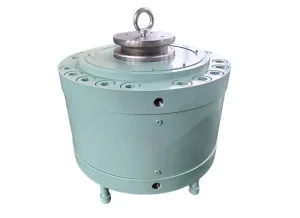
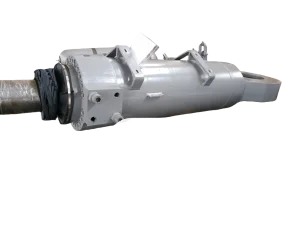
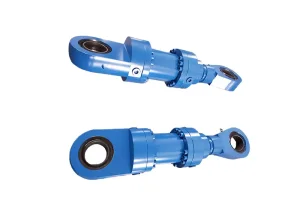
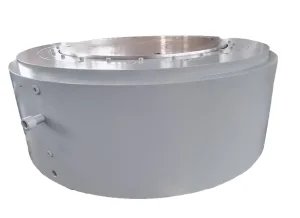
Send Inquiry NowExplore our full line of cement machinery, mill loading, roller press, and hydrostatic servo cylinders built for severe duty industrial applications.
Clear, engineering-focused answers addressing specifications, OEM compatibility, lead times, and environmental standards.
Hydrostatic support cylinders utilize external pressure pumps or internally diverted high-pressure fluid channels to supply constant hydraulic pressure into multi-recessed pockets along the guide bushings and piston. When severe side loads occur (e.g., during uncrushable tramp metal events in mining crushers), the oil film gap narrows on the side receiving the force. This restriction raises localized fluid pressure inside that specific pocket, generating a self-balancing hydrostatic force exceeding 300 kN. Because the rod literally floats on a 15–35 µm oil film, metal-to-metal contact is entirely prevented, eliminating scoring and bore scuffing.
Yes. Xuanda manufactures custom hydraulic loading and tensioning cylinders designed to mirror original mounting dimensions (ISO 6020/2, DIN standards), hydraulic pin connections, sensor bracket interfaces, and pressure parameters of European and international OEMs including Loesche LM, FLSmidth ATOX, Pfeiffer MPS, UBE UM, and Chengdu Leejun CLF roller presses. All OEM names are trademarks of their respective owners; Xuanda supplies fully compatible high-durability replacement cylinders.
For actuators operating in sub-zero Nordic climates (-40°C), cylinder barrels are fabricated from high-strength alloy forged steel (such as 42CrMo4 or 35CrMo), while piston rods are machined from quenched and tempered 42CrMo4 or 20MnV6 steel. Material heat treatment includes full quenching and tempering, and all raw materials undergo Charpy V-notch impact testing at -40°C ensuring absorbed impact energy exceeds 27 Joules in compliance with EN 10204 3.1 certification requirements.
Hydrostatic Support Cylinders float the piston and rod on a continuous pressurized oil film, providing zero static friction ($\mu < 0.001$), infinite seal wear life, and massive side-load resistance. Clearance Seal Cylinders rely on ultra-precise mechanical tolerances ($2-5\,\mu\text{m}$ gap) between the honed barrel and piston, offering extremely high dynamic frequency response with minimal leakage without elastomeric contact. Low-Friction Seal Cylinders utilize modified PTFE compounds with energizing O-rings to minimize stick-slip while maintaining zero static fluid leakage for standard industrial hydraulic loops.
Yes. If original technical drawings are missing, our engineering department can work with field measurements, nameplate data, worn sample photos, or mounting dimensional sketches provided by your maintenance team. We perform 3D CAD modeling and stress calculation checks, sending complete approval engineering drawings to your engineering team in Sweden prior to manufacturing.
Every shipment includes a comprehensive Quality Inspection Dossier containing: (1) EN 10204 3.1 Material Certificates for steel forged components; (2) Ultrasonic (UT) and Magnetic Particle (MT) NDT inspection reports; (3) Hardness testing & plating thickness logs (Chrome/HVOF layer); (4) Pressure test charts showing holding pressure and zero-leakage verification; and (5) Dimensional CMM measurement reports.
Standard manufacturing lead time for custom engineered hydraulic cylinders ranges between 3 to 6 weeks depending on size and material forging requirements. Express air freight can deliver critical replacement components within 5 to 7 days to Gothenburg or Stockholm Arlanda Airport. Standard ocean container transport to the Port of Gothenburg, Stockholm, or Luleå takes approximately 28 to 34 transit days.
You can initiate a direct engineering inquiry by clicking the "Send Inquiry Now" button below or contacting our sales engineering department at [email protected]. Please include operating pressures, required stroke/bore dimensions, mounting style, and machinery position for an immediate technical proposal and competitive quotation.
Partner with Changzhou Xuanda Hydraulic to eliminate cylinder stick-slip, resist severe lateral loads, and extend MTBF across your heavy machinery operations.
Send Inquiry Now